

“… the way tourism has enabled some of this work was so beautiful and hopeful.”
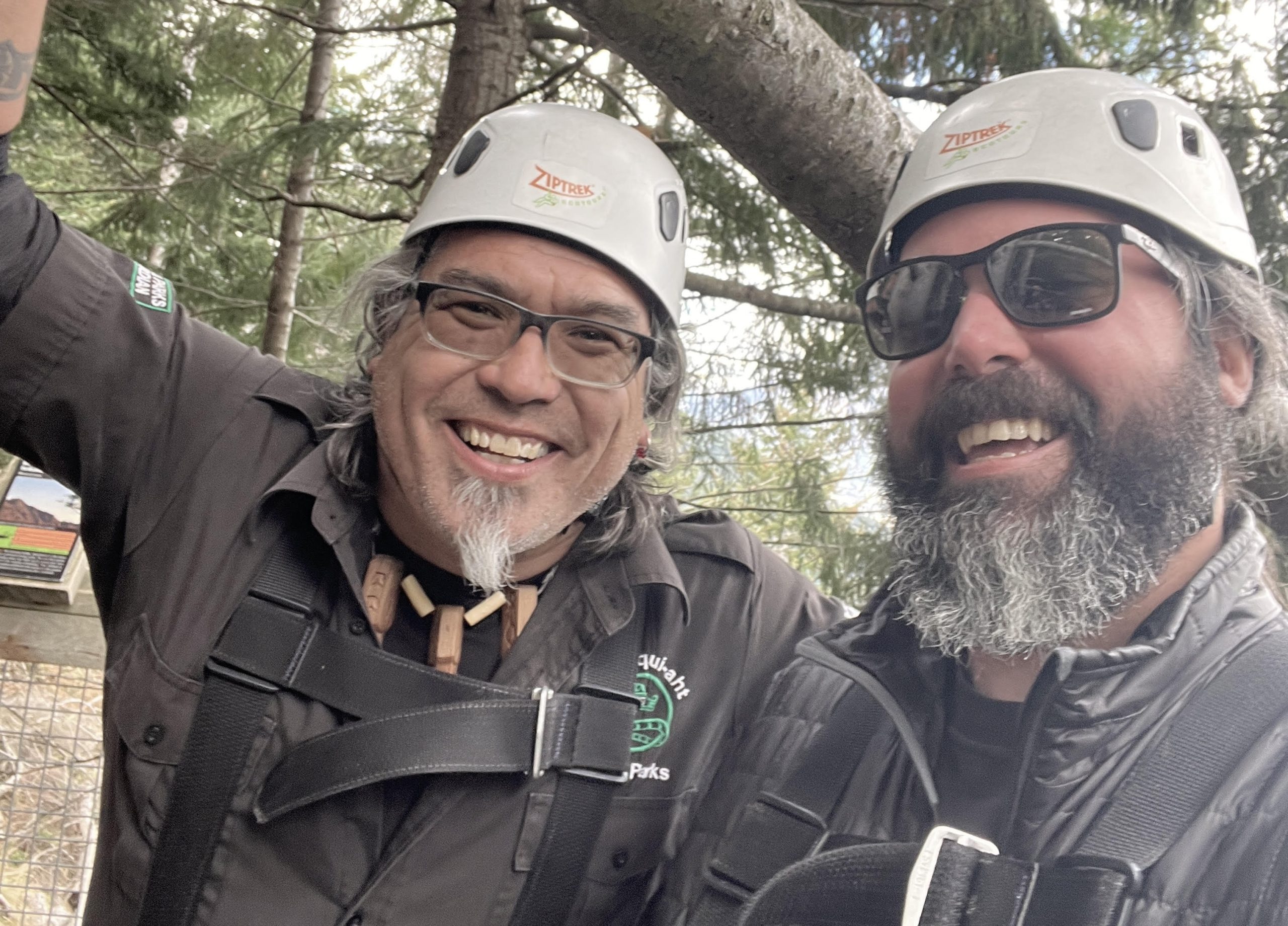
This is a challenging time to advance Indigenous rights, sustainability, and social justice initiatives within the tourism industry, particularly in North America. It’s easy to feel discouraged by the lack of commitment from the top down in government and by the inertia one can feel when pushing from the bottom up through grassroots initiatives. However, my recent trip to Destination Think’s Forum 2025 event in Aotearoa New Zealand was exactly what I needed to refresh my perspective and double down on my efforts in this important space. I travelled alongside Tla-o-qui-aht leader Saya Masso, met some cool new friends, and returned home energized with new ideas. Here, Saya and I will share some important things we learned at Forum and how we’re moving toward a more equitable tourism industry.
“Inspired by conversations with other leaders in the tourism management world,” says Saya, “I have taken on a swath of new projects and initiatives that will enhance Tla-o-qui-aht’s relationship to the tourism industry. The ability to see, learn, absorb, and then find paths to action as a result of the conference will literally have generational impacts here.”
I had the privilege and responsibility of leading Tourism Tofino as Executive Director for three years beginning in November 2022. Tofino is located in unceded Tla-o-qui-aht First Nation territory on the west coast of Vancouver Island in Canada. It is home to a few thousand people and receives an estimated 750,000 visitors per year. We have been working collaboratively with Tla-o-qui-aht and other Nuu-chah-nulth First Nations to ensure Indigenous rights and voices are upheld and respected in tourism, and that Indigenous folks benefit from a local tourism economy generating hundreds of millions of dollars each year.
The opportunity to travel to Tāhuna Queenstown with my friend Saya Masso, Natural Resources Manager for Tla-o-qui-aht First Nation, was made possible by Destination Think and Tourism Tofino. Travelling to conferences and other learning opportunities with representatives from First Nations has been a great way to build these relationships and be exposed to new ideas together. There is also nothing that builds bonds like missing flights and being stuck in airports together! In terms of inspiration, though, we couldn’t have picked a more perfect trip than Forum 2025.
There is something in the water in the Queenstown Lakes region. Enabled by community values to protect the environment, strong te iwi Māori leadership, an impressive amount of local venture philanthropy, and lots of smart and passionate people tinkering with aspects of sustainability, Queenstown has set an audacious goal to achieve a carbon-zero visitor economy by 2030. Over the few days we were there, we saw so many examples of tourism being used to test proofs of concept, provide opportunities to learn, mobilize community action, and ultimately regenerate the natural environment.
See also: 5 green themes from an energizing Forum 2025 in Queenstown, Aotearoa
“As a DMO, find your destination’s lighthouse examples and champions, and elevate those efforts. Rely on your allies and partnerships and start the momentum where you can.”
A highlight for me was a night out for dinner and a lively conversation between Saya and Mike Rewi, a local Māori leader and CEO of Mana Tāhuna Charitable Trust, which does amazing work in all kinds of spheres, including environmental restoration. The two passionate Indigenous leaders from distinct cultures shared many similar values and history – including early encounters with Captain Cook on opposite sides of the Pacific and the ongoing colonial impacts on both peoples. The exchange of ideas about what each was doing to restore their territories and the way tourism has enabled some of this work was so beautiful and hopeful. It was a powerful reminder that Indigenous leadership and insight are needed now more than ever in the tourism industry – no matter where you are.
A week or so after returning home from the trip, I visited Saya at his home in the ancient village of Opitsaht on Meares Island, across the harbour from Tofino. It was an opportunity to reflect on what we saw and learned in Queenstown and what tangible actions we could take in Tofino as a result. We ended up with a long list of inspiring possibilities.
Here are the four key themes from what Saya and I learned at Forum in Queenstown, which include some tips for destination managers:
1. Educate visitors
Monique Kelly, General Manager of the NGO called WAO, reminded us that in tourism, we are in the business of education. People travel to learn and experience new things. There is a huge opportunity to weave education about sustainability and Indigenous culture through our experiences, as we saw during a visit to Ziptrek Ecotours. A well-informed and thoughtful visitor will also put less pressure on a destination. As Saya said, “An educated visitor is worth a million dollars!” He and I immediately began brainstorming ways to weave more educational elements through the work we do, seeing the vast potential ahead for Tourism Tofino and the First Nation
2. Incentivize visitors
Rikke Holm Peterson from Wonderful Copenhagen also joined us at Forum 2025. From her, we heard firsthand about the development and implementation of CopenPay, which incentivizes visitors to make more sustainable choices during their visit to the city. This idea can be replicated. Saya and I immediately identified the opportunity to “CopenPay” the ʔiisaak Pledge (developed by Tla-o-qui-aht First Nation) by rewarding visitors for ethical travel when in Tofino. Our teams are currently designing that program.
See also: Culture keepers: Showing visitors what it means to be Nuu-chah-nulth
3. Encourage grassroots incremental change
We were incredibly inspired to see small, grassroots movements all over Queenstown tackling issues like reducing the waste produced by the tourism industry, rapidly electrifying the industry to decarbonise, eradicating invasive pests, and restoring natural habitats. “A lot of a little is a lot!” is one mantra we heard a lot. Start small as you work on the big systems changes that tourism needs. As a DMO, find your destination’s lighthouse examples and champions, and elevate those efforts. Rely on your allies and partnerships and start the momentum where you can. I needed that reminder!
4. Build cultural capacity and revitalization
After the Queenstown trip, Saya spent a few days in the North Island visiting the Turongo Collective’s Te Whānau Āio cultural experience in Auckland and the New Zealand Māori Arts & Crafts Institute at Te Puia in Rotorua. He relayed to me how moving and inspiring it was to see Indigenous youth being taught to proudly carry forward cultural traditions like songs, dances, carving, and weaving. The Te Puia model uses visitor dollars to help fund scholarships for Māori youth. It’s a powerful model of tourism supporting cultural revitalization.
Saya and I came back home so fired up about the possibilities of a regenerative future of tourism in Tla-o-qui-aht territory and how the First Nation can lead the incremental changes we need to see for an abundant future. As a destination leader, look to the First Peoples of your area to plan and imagine the future. What makes your destination unique isn’t hotels or restaurants – the local culture is the differentiator. But planning for the future relies on solid relationships and reciprocity. Take the time to share meals with Indigenous leaders, invite them to conferences or professional development opportunities, build your capacity and inspiration together, and co-create a more equitable and sustainable tourism industry.
Destination Think is grateful to Saya Masso for sharing his knowledge and to Brad Parsell for contributing this guest article and photo.



All good … but I’d appreciate seeing and hearing the word regenerative tourism being used more and used as a model for where we need to go .. regenerative tourism does all mentioned above but also ensures a percentage of the big industry’s profits go directly into the local community .. infrastructure / recreation / water and sewer etc