

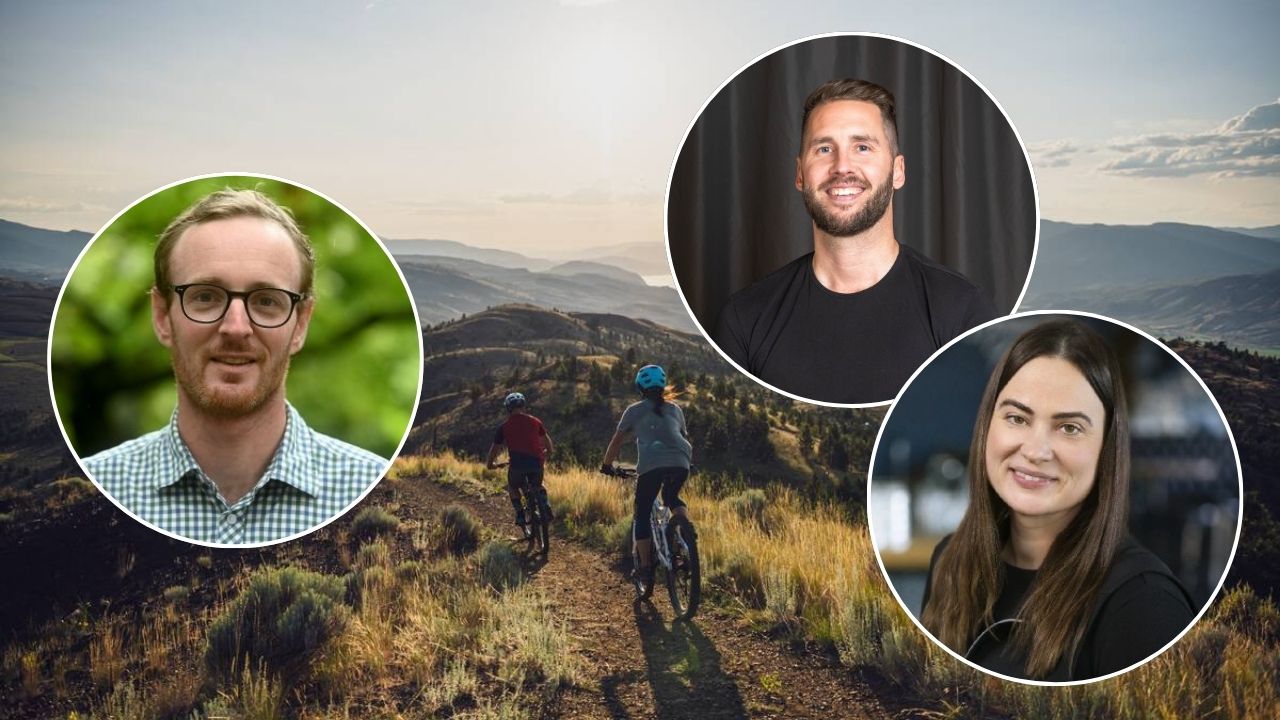

Economist Benje Patterson shares practical tips to find the resources your community needs to maintain trail networks.
Don’t underestimate the value of your local trails. In Aotearoa New Zealand, trail tourism generates more than a billion dollars per year, says Benje Patterson. A good portion of that comes from the Queenstown area, where Benje has studied the growing impacts of biking and trails. His 2025 report on biking’s contribution to Queenstown Lakes’ economy says that about one in six visitors to Queenstown rode a bike during their visit – up from one in eight at the start of the decade. For 41.7% of those visitors, biking was the primary reason for their trip.
But the increase in activity doesn’t automatically translate into an increase in funding for trails – especially for trail maintenance. What can destinations do to secure that funding, and what can we learn from Queenstown’s experience?
As part of a project within the Destination Think Collective, we invited two Canadian destination leaders to sit down with Benje to talk about shared challenges in funding trail networks – especially trail maintenance – and the lessons from Queenstown’s successes.
Mike Overend is with the Thompson Okanagan Tourism Foundation, a non-profit organization founded by the regional destination organization. The foundation is supporting a project led by Tourism Kamloops called the Freeride Fund, led by Carmen Herman. Starting with seed funding of $50,000, the fund seeks to direct some of the community’s revenue from tourism toward maintaining local trail networks.
During the conversation, Benje shared some tips for destinations seeking to find consistent funding for trails that doesn’t rely solely on grants:
- Think about strategy first when developing trails. To help make your case for funding, determine the potential demand for new trail systems and how they could drive economic activity.
- Measure the local impact trails are already making to help tell the story and increase community buy-in. Installing trail counters is one example.
- Make an emotional connection by tying donations to a specific thing people can see. Benje gave an example of community members sponsoring planks in a new bridge to cross a river.
- Create a menu of options for community members and businesses to contribute to trails at different levels.
- Provide ways for visitors to give while showing them how the trails they’re enjoying make life better for locals, too. For example, ask for donations at the bike rental shop. “Did you know that 5,000 children in this local area use the trails each year?”
Catch the full episode on Travel Beyond through Apple Podcasts, Spotify, or your favourite player.
Show notes
- Freeride Fund – A project to fund trail maintenance created by Tourism Kamloops with support from Thompson Okanagan Tourism Foundation.
- Six unique trail funding solutions – Ideas published by American Trails.
- “Planks a million” – Queenstown Trails blown away by Plank Sponsorship support – A news story about a successful fundraising initiative.
Research by economist Benje Patterson:
Destination photo provided by Thompson Okanagan Tourism Association.
Episode transcript
Benje Patterson: What a cool story, that of the hundred dollars you’ve just spent on your bike hire, five bucks is going into this world-class trail infrastructure that you are enjoying. And look at all the smiling children and families out there riding the locals. You are helping fund their recreation. And that’s something that actually can help sell bike hire to the visitor.
David Archer: Welcome to Travel Beyond. I’m David Archer from Destination Think, recording from Haida Gwaii, the territory of the Haida Nation off the north coast of British Columbia in Canada. On this show, we look at travel’s role in making a better world, and we highlight leading destinations and change makers.
Our guests are taking local action that the world can learn from. They’re helping to regenerate ecosystems, communities, and economies, and they’re often making positive change happen from the bottom up. Many of the voices we’ve highlighted are part of the Destination Think Collective, a global alliance of ambitious, forward-thinking destinations, working toward a better future for travel and the planet.
Today’s show is all about trail networks and a particular challenge that many destinations face: how to establish consistent funding for trail management, and especially ongoing maintenance.
To learn about that, I recently met with two Canadian destination leaders and a New Zealand economist. We talked about how you can make the case for the value that trails and tourism bring to your community, along with some examples of successful storytelling to help your trail networks stay thriving.
Mike Overend: My name is Mike Overend, and I work with the Thompson Okanagan Tourism Association. We’re based in the interior BC, Canada. We also have a subsidiary foundation, so the Thompson Okanagan Tourism Foundation, which we established in 2018.
The whole reason why we established the foundation was for our trail networks. So, back in 2015, we identified a prominent rail trail in our region, the Kettle Valley Rail Trail as a, a great opportunity to bring more visitation into our area, sustainable trail development. And one of the things that we got out of a strategy that we completed in 2015 was to create this foundation because the funding in place for trails in our region wasn’t very substantial. You know, we were relying heavily on government funding. So to be able to kind of bring in a foundation that focused entirely on keeping trails and our trail systems healthy and maintained was the point.
I’ve worked with numerous communities like, for example, Carmen in Kamloops, uh, Tourism Kamloops, I’ve worked with them, and with other communities in our region on specific projects relative to trails. Typically what I’ve done in the past is applied for grant money through a provincial government or federal government.
And through that money that we receive, we’re able to implement these projects. One of my biggest focuses moving forward is – without having to rely on grant money, which will still continue to be a source of some revenue – but how can we expand that to be more community-driven, partnership-driven. Even visitors, how when they’re coming into the area, how do we kind of tap into that resource from a fundraising perspective?
So that’s really a big part of what I’m doing.
Carmen Herman: Hello, I am Carmen Herman. I am the director of Brand & Marketing for Tourism Kamloops, which is a beautiful city located in the TOTA region that Mike spoke about. And we are known for outdoor adventure, our deserty landscape, and we love mountain biking.
Freeride lives here in Kamloops. We have campaigns. We put dollars into these campaigns, and have done feasibility studies. We know our economic benefit to bringing mountain bikers here. But with our close relationship with the local bike clubs, we realized that, in a way we are also creating harm and overuse of trails.
And these trail maintenances are, are run by local volunteer groups. So, essentially, that kind of sparked a community-driven initiative called the Free Ride Fund. So Tourism Kamloops stepped up with some funding dollars over the next three years. We’re on year two of that now to, to reinvest directly into our mountain biking trails.
We have committees that, decide on what trails need maintaining from the funds, that are collected and, basically our, goal is to help create a sustainable way to support the maintenance long term.
So we want, the community of Kamloops to, be proud of their trails and, maintain it, and keep them going for years to come.
Mike Overend: I do wanna also clarify that working with Tourism Kamloops on their project, it’s through our foundation that the donations are coming.
because we’re a charitable organization, we’re able to do that and that’s kind of the synergy that we have with Tourism Kamloops, although it’s entirely their project, it is running through our foundation. That’s kind of – we wanna be able to provide that umbrella organization for those types of things.
David Archer: To learn more about the Freeride Fund, our listeners can visit the Tourism Kamloops website. We’ll have links in the show notes. For the rest of our conversation, Mike and Carmen joined me to interview economist Benji Patterson, based near Queenstown in Aotearoa New Zealand. Benji has researched the economic and community impacts of trail systems in New Zealand and elsewhere, and he gave us some good examples of telling the story of that impact in ways that resonate.
Benje Patterson: G’day, my name’s Benji Patterson. I’m an independent economist from New Zealand. I live in a small village called Arrowtown, which is nestled beside Queenstown. That’s New Zealand’s premier tourism destination, and it is a mecca for biking, and other trail use – walking, running, as well as skiing in the winter time.
Alongside being an economist, I’m also a competitive ultra runner competing internationally, and I am a trustee of the Queenstown Trails Trust. So I have firsthand experience in not only the development, but also the management of the trails network here, which is a key economic driver for our region.
As an economist with an interest in the trails, I’m quite often asked to value what they’re worth to local communities. Sometimes that’s, “What are they worth in their entirety?” Sometimes it’s because a new trail development is being planned, and at other times it’s simply looking at an event that leverages off the trails, what’s that bringing into the local area?
So I do a lot of that work within New Zealand and also in Australia. And what we’ve found here in Queenstown specifically is that at present, it’s more than one in every six visitors are coming and biking while they’re here. And that’s risen from one in every eight, when COVID sort of first hit. So, since the COVID pandemic, we’ve seen that more people are biking.
We’re seeing that it’s slightly higher rates of participation among international visitors to Queenstown with domestic tourists – they’re still biking, but not quite as frequently as the internationals. And what we are seeing is that almost half of these visitors are saying that biking is a primary reason for actually coming here in the first place.
And so it drives a lot of money in our local economy. It’s about 10% of visitor spending can ultimately be attributed to the bike economy. So it’s moved from something that was, I guess, a bit of a niche industry a decade ago into something that’s quite a powerhouse in its own right.
Mike Overend: You kind of touched on already a little bit, but just, I wanna get an overall sense of why you undertook the research in the first place. The thing that I’m really curious about is what has the value of that research been since then? Like, how has it been used to tell that story?
Benje Patterson: The research that I’ve done on into the economics of the trails has been particularly important for grant applications. So when our Trails Trust is asking for money to support trail developments from government funders, often the government wants to understand what the economic impacts are.
So it’s been really important from that perspective, but it’s not only when seeking funding from the government that it matters. It’s also when we are trying to solicit enthusiasm from the private sector into the value of trails.
For a long time, a lot of businesses would just see it as something that happened around them that it wasn’t driving a lot of demand and economic activity, but a lot more businesses are waking up to the fact that there is significant profits that can be made from co-locating amenity close to trail nodes and close to trail corridors. And so we’re actually seeing a lot of private sector investment now happening around the existing trail network and also ahead of time in anticipation for new trails that are opening.
Mike Overend: As far as the actual research, were your findings surprising, for one, and how do they stack up against other economic sectors in your area? Like, can you take the findings to the, to your local or regional government and say, tourism actually is number one, or whatever the case may be. How does that look in Queenstown?
Benje Patterson: So one of the questions that was posed to me by a particularly influential philanthropic backer of cycling a couple of years ago was, “I just wanna know how big this thing is compared to ski.” And that was all he wanted to know. And the main reason is we were known as a ski town. He really liked his biking, and he was frustrated that other people didn’t seem to understand that biking was quite a big deal.
And so we worked out that, this was a few years ago, that biking at that stage was already about a third of the size of the ski economy, and it was on a trajectory to reach about half the size of the ski economy. And while I haven’t compared the two recently, my most updated bike research suggests to me that it probably is about half the ski economy now. And that’s really when people take notice, because from, I guess June through to September each year, everyone’s wearing ski gear. Everything’s congested with skiers. You see them every day. And so it was hard for people to realize that these people just pedalling along trails. They were such an important economic driver.
Mike Overend: Yeah. Yeah, and we have similar seasons here, so ski season’s very popular as well. It’d be interesting to do a similar study in our area about the impact of biking versus skiing.
Um, and I think it’s closer than we all assumed initially.
Benje Patterson: Yeah, I, I think one of the important things to point out is that the cycling economy is also very broad, and I would say it’s much, much broader than the ski economy.
So the ski economy –
Mike Overend: yeah,
Benje Patterson: – is, is obviously predominantly fixated on taking a lift up and heading down, and you need to be, you know, quite active and fit to do it and to enjoy it. Whereas the bike economy, I think. It allows for a much wider spectrum of fitness levels, of ages, stages, and risk profiles. So at the very easiest, you can be riding a completely flat five-metre wide, gravelled trail between vineyards, right through to a World Cup-standard downhill track. And so we’re able to capture that really, really broad spectrum of rider. So it’s much more approachable and accessible. And this is despite being a keen skier myself, it’s just when I look at the economics, I see that it’s a much bigger circle of potential demand we can go after.
Carmen Herman: How do we get the visitors to feel that story as well and want to contribute to the trails that they’re riding?
Benje Patterson: It’s funny that even though we are flourishing as, as a bike economy and attracting a lot of visitors, we are still struggling to connect those visitors with the actual maintenance and investment into the trails. So in terms of building trails, we seem to get the money when we need it through a variety of philanthropic sources. We’ve got incredibly deep-pocketed, high net worth individuals that live here, and so often when you challenge them to be involved, they will come to the party and then help challenge others. And so then we will match that with community fundraising campaigns and at times topping it up with support from government or other local charities and trusts.
But when it comes to the maintenance of trails, that is increasingly becoming a problem for us. We’ve been very fortunate that our local authority has almost, on a handshake agreement for a very long time, been taking over the maintenance of trails as we build them.
But with severe weather events, it becomes more problematic to have those responsibilities. And while government gives us funding for severe weather events, those funds can quickly get exhausted if you layer multiple weather events across New Zealand. So when it comes to the maintenance, we have begun to activate local businesses that aren’t necessarily directly involved with the trail community, but see the value in it to become supporters, corporate supporters. That’s an important funding source that we’re getting into the organization.
But the bit that we are still struggling to really unlock is how visitors themselves can directly contribute to the trail maintenance. The idea of getting people to scan QR codes and that type of thing – they don’t seem to go for that. We have those types of things in place, but we find that very few people actually will make those types of donations. It’s definitely not as easy to get money out of people in those ways.
And I guess if I think about things at a personal level, if I just see a QR code somewhere that says, “Hey, did you have a great ride? Why don’t you donate?” I might not bother taking my phone out of my pocket, even though I really did have a good ride and enjoy it.
Mike Overend: Yeah.
Carmen Herman: Yeah.
Benje Patterson: But if someone says to me when I’m hiring my bike, “Hey, do you want to give five bucks to the trails? Did you know that, you know, 5,000 children in this local area use the trails each year? Would you do that?” I’d say, “Sure. That sounds awesome.”
We have had some success with selling lovely souvenir-type trail maps that are well done, that provides some funding.
Carmen Herman: Mm-hmm.
Benje Patterson: We’re also fortunate that we have a couple of our major bike hire companies will make donations per visitor to the Trails Trust. But the reality is that’s not widespread across all trail operators.
In this situation, we actually lack the legislative and regulatory levers to coerce all commercial users of the trails to pay a certain amount of their revenue into trail maintenance. And it’s something that frustrates me, because, as a visitor, what a cool story if that, of the a hundred dollars you’ve just spent on your bike hire, five bucks is going into this world-class trail infrastructure that you are enjoying. And look at all the smiling children and families out there riding the locals. You are helping fund their recreation. And that’s something that actually can help sell bike hire to the visitor.
David Archer: Beyond having visitors contribute to trail funding, Carmen and Mike also asked Benji about getting the community involved.
Benje Patterson: So, on one hand in New Zealand, we have a government agency that coordinates cycle trail funding in general, and that’s sort of a top-down approach. They’ll tell the big macro stories about the sector in New Zealand.
But the reality is, when you live in a small community. You don’t care about the macro story for your country. You care about what’s happening locally and tangibly. So it’s very important to measure things from the bottom up and to tell those local stories.
So as a trustee of the Queenstown Trails Trust, I always advocate very strongly that we measure what we are doing, and the staff that work from for our organization have a very long track record of doing that. And whenever a new trail goes in, they will always make sure that a trail counter is put in place, for example.
We need to be able to measure what’s happening so that we can tell the story of how much riding that is activating. And we know from seeing who turns up onto the trails that that’s not only visitors on bikes that they’ve hired when they’re here, but there are a lot of community members that are using the trails every single day.
So it’s a really nice way to build up the social license of the visitor sector when you’ve got infrastructure that’s enjoyed by both visitors and locals alike.
Carmen Herman: I’d love some examples if you have any of any specific project or initiative that kind of got the community a bit more excited, and you saw engagement and got more people involved.
If you have any specifics on, or some tips on, you know, how to, how to capture the community and how to build that excitement with them.
Benje Patterson: So there was a recent trail opened here along the Shotover River. It was quite exciting because the manager of our Trails Trust had heard rumors that an old gold mining tunnel was down there. And he scurried around in the scrub and prickles and found it and, and restored that and brought it back to life. And that really excited the community.
We were very fortunate that we got some great philanthropic funding for that tunnel, but then we got to one other problem on that on that trail, and that was that we also needed a bridge across the river. And while we are very lucky to get philanthropic funding for some of the bridge, there was a realization that there was a bit of a funding gap.
So the staff came up with a fantastic community campaign of sponsor a plank on the new bridge, and almost overnight they sold, you know, a hundred-odd of these planks to cross the river. And it was this bite-sized, I guess, amount of funding that each plank was. And it was really tangible, because someone, you know, could see their name on a plaque and be like, wow, I helped get that bridge across the river. And that was wildly successful. And that’s actually one of the trails that has massively exceeded expectations since it opened with the trail counts that we’ve been seeing. So that was, that was a really exciting project to see, getting the community involved in.
Carmen Herman: Yeah, that’s something tangible for them to go and visit and be proud of.
Mike Overend: I love that. Have there been other events or ideas similar to that, that you’ve seen that have worked from a community buy-in, but also fundraising standpoint? That’s a great example.
Benje Patterson: We’ve had a whole range of other initiatives. We have a month each year where we have a trail lovers campaign. We have a variety of activations trying to raise funding. There have been other bridges in the past where a variety of people have been tapped on the shoulder to, to put in money, and so things are often ultimately successful, but, but this particular campaign was just, I guess, different because it happened so incredibly rapidly and it was tied to something that was just so tangible. And that’s the thing that people want to help, and that they want to, they wanna be able to see how they fit it into the mix.
Carmen Herman: Mm-hmm.
Benje Patterson: So that idea of tying specifically to a tangible thing is very helpful. So in the future, you know, that might be along a trail corridor, potentially, you know, funding a water station or a bench for people to sit on and enjoy the view. I think those are the sort of things that we need to look to. And in fact, I know that when we are looking around for funding in the community, it’s often quite a good idea to have a bit of a menu of options. So if someone’s interested in backing it, you can tangibly tell them, well, if you give $5,000, we could put it towards this for you.
Carmen Herman: Mm-hmm. A little bit of a look-book of donations, yeah.
Benje Patterson: Yeah.
Mike Overend: And you, you had mentioned previously about businesses’ involvement. Have you created any other programs or are you aware of any other programs that involve the business community in giving back to trails?
Benje Patterson: Yeah, so there, there’s a network of businesses that are partners of the trails. So we’ve got a fundraising manager that works on developing those relationships with businesses, and they span all sorts of businesses from bakeries to supermarkets to real estate firms and other people in professional services. So they’re not all businesses that are actually directly involved in the recreational sector. And they will put money towards it each year, and that’s, that’s really good to have a baseline level of funding into our organization. It’s incredibly helpful.
When it comes to businesses that actually actively derive revenue from the trails themselves, that sell products that rely on the asset that’s been developed by the community, that’s where things get more problematic. I would’ve thought that’s the easiest, I guess, group of businesses to activate, but it’s actually been quite hard. We are really lucky that we do have some businesses that see the value in being a responsible corporate and giving some money from their bike hires directly to the Trust and then telling their customers that they’re doing so. But not all businesses are doing that.
Some do want to free ride, and it’s incredibly frustrating because I actually think it can be a net win to them if they were to voluntarily start to make those donations and to tell their visitors that’s what was happening and get their visitors really enthused. It’s great collateral.
Our trails, they connect the area really extensively. So they not only go into the mountains and throughout the basin and the valley, but there’s quite an effort to make sure that they connect into both residential neighbourhoods as well as into areas where there are commercial businesses. So we are increasingly seeing that businesses, while they’re not directly related to the trials themselves, they are seeing increased business. And that can be often, you know, hospitality establishments along the trails themselves. People go have lunch, they might go visit a vineyard. And in some situations, what you’ll see is that bike hire companies will create itineraries where you’ll cycle away from the depot, and then you’ll end up somewhere, you might wine and dine, you might do a little bit of shopping, and then they’ll collect you and take you back to the starting point.
So those sort of integrations are really important because you can create a trail, it might be highly used, but if you wanna spread those economic benefits, it needs to have amenity either along it or co-located at those trail nodes, and so that’s something important to get right.
And so I think it’s the manner in which you intercept the visitor and the way that you tell them the impact of what they’re doing. I don’t think you should be passive about it. I think it’s important to be quite forward and genuine and to make them feel involved in that they’re doing something really nice and really good that’s transcending what they’re actually doing on that particular day as, as a visitor.
Mike Overend: I do have one more question. From my standpoint, I think a lot of organizations will be at different levels of where they’re at. When it comes to trail development, Queenstown seems to be quite advanced, which is great. If there was a organization like a Trails Trust that just started up, or the Thompson Okanagan Tourism Foundation that just started up, what would be your process of working through that? Like, first things first, finding out the economic value of trails in the area. How would you build that up?
Benje Patterson: I think it’s important to get your strategy right from the start and to actually understand who will be using your trails.
One of the challenges in New Zealand is, because there have been places that have been incredibly successful in driving economic benefit from the trails, like Queenstown, like Rotorua, we’ve also got a lot of places where these trails have been constructed and, cool, it’s a trail that goes between places. You can ride it, but it’s not actually that well used, and the ROI is not particularly high. It’s not something that’s gonna lure in the visitor, and it’s not a particularly compelling option for a local, or there are, frankly, not enough locals to go and enjoy it. So I think it’s getting real from the start as to what your potential demand will be.
That’s really important as part of the mix. Because if your potential demand is going to drive a lot of economic activity, you’ve got a much easier pathway to getting funding. If it’s gonna be well utilized by the local community, then, of course, there’s gonna be different funding avenues that you go down, and understanding what that local community usage might be is important for appealing to those local funders or to people in the community that might be volunteering into the initiative. Because, while we don’t utilize as many volunteer hours these days within our organization, around the rest of New Zealand there are a lot of organizations involved with managing cycle trails and bike parks that do rely on dig nights and on volunteer hours, so it’s an important part of the mix.
David Archer: This has been Travel Beyond presented by Destination Think With many thanks to economist Benje Patterson for joining us. Thanks as well to today’s guests and temporary correspondents, Mike Overend with Thompson Okanagan Tourism Association and Carmen Herman with Tourism Kamloops. You can learn more about the Freeride Fund, the Thompson Okanagan Tourism Foundation and the work of economist Benje Patterson through the show notes posted on our website at destinationthink dot com.
I’m David Archer, your host and producer today. I also composed theme music. Amy Bjarnason, Lindsay Payne, and Rodney Payne provided production support. Thanks for listening.




0 Comments