

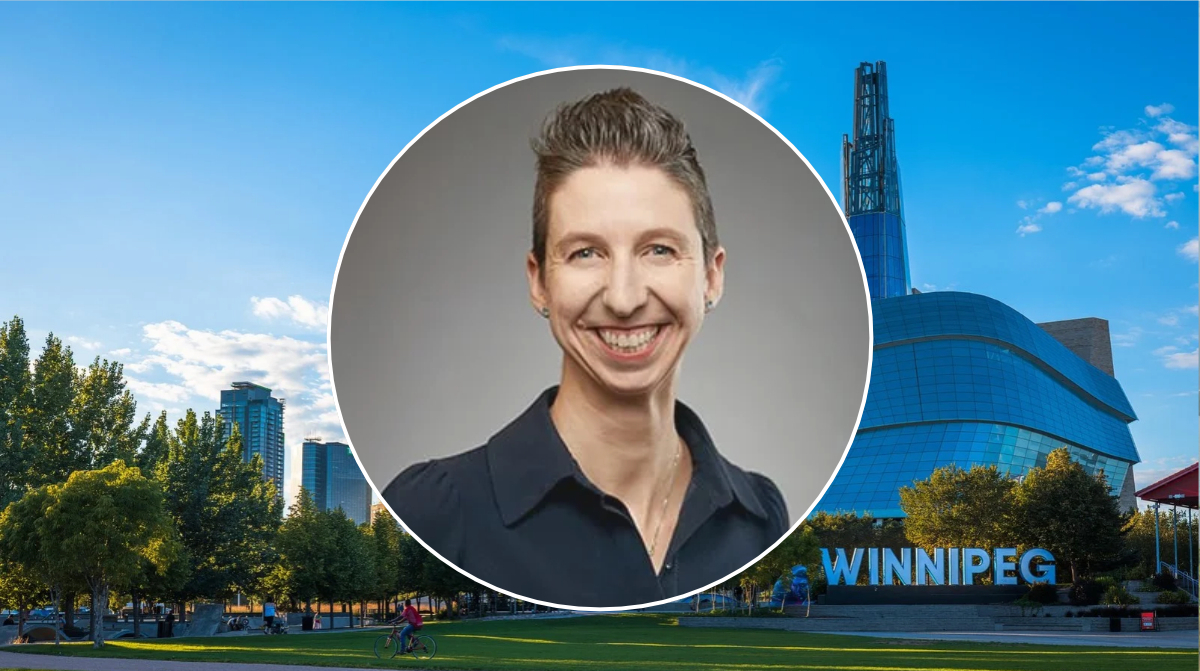
“For other DMOs […], I think it’s about really taking a step back, listening to the Indigenous leaders in the community and co-creating with them what that journey looks like.” – Natalie Thiesen
This destination’s ongoing journey of reconciliation shows what’s possible when tourism leaders make trust-building with Indigenous communities a priority, and are willing to make structural changes to back it up. Natalie Thiesen, Vice President of Tourism at Winnipeg Economic Development & Tourism, tells guest host Brad Parsell, CEO of Kootenay Rockies Tourism, about her organization’s last three to four years on that journey. She leads tourism in a multicultural city with Canada’s largest urban Indigenous population, home to the Canadian Museum for Human Rights and the National Centre for Truth and Reconciliation.
Winnipeg’s 2026–2030 strategy, which guides both tourism and economic development, places reconciliation at the core. For example, under the goal Advance Winnipeg together, it commits to “advance economic reconciliation to support inclusive growth.”
Before setting priorities, the agency put the right governance in place. An Indigenous Advisory Council, chaired by board member Dennis Meeches, brought Indigenous Tourism Manitoba and the Manitoba Métis Federation to the table. The process began with ceremony and with education for the board, management team and staff about decolonizing the organization’s approach. From her work on other boards, Thiesen has found that organizations make the most impact and earn the most respect when Indigenous leaders guide the process and no one imports a one-size-fits-all model from elsewhere.
For destinations that want to support Indigenous tourism development and respond to the Truth and Reconciliation Commission’s calls to action, Thiesen’s advice starts with listening. Reach out, invest time in relationships, meet people where they’re at and be open to a path you didn’t expect.
On this episode of Travel Beyond, you’ll learn:
- Why Winnipeg Economic Development & Tourism puts truth and reconciliation at the core of its strategy.
- How economic reconciliation became an objective under “Advance Winnipeg together,” one of three goals in the agency’s 2026–2030 strategy.
- How Winnipeg’s DMO built the right governance, starting with ceremony and an Indigenous Advisory Council chaired by board member Dennis Meeches.
- How Winnipeg uses earned media, bringing journalists and content creators into Indigenous and other cultural experiences first-hand.
Subscribe to Travel Beyond through Apple Podcasts, Spotify, or your favourite podcast player.
Destination photo provided by Winnipeg Economic Development & Tourism.
Show notes
Canadian Museum for Human Rights – Opened in Winnipeg in September 2014 beside The Forks, it was the first Canadian national museum built outside the National Capital Region and is devoted entirely to human rights.
Indigenous Tourism Manitoba – The province’s lead Indigenous tourism organization, led by CEO Holly Spence, which helps Indigenous businesses become market ready and sits on Winnipeg’s Indigenous Advisory Council.
National Centre for Truth and Reconciliation: Reports and Calls to Action – Hosted by the University of Manitoba in Winnipeg, the centre holds the Truth and Reconciliation Commission’s records and shares its 94 Calls to Action free online.
Rendez-vous Canada 2025: Welcoming the world to Manitoba – Travel Manitoba’s overview of the May 2025 international tourism marketplace in Winnipeg, where Indigenous inclusion guided every subcommittee and every familiarization tour.
Turtle Tours at The Forks – The First Nation-owned, Indigenous-led company behind the 45-minute walking tour of treaty, land and history that Winnipeg now offers visiting media and content creators.
Winnipeg Economic Development & Tourism: Our strategy – The agency’s 2026–2030 strategy, whose third goal, Advance Winnipeg together, includes the objective to “advance economic reconciliation to support inclusive growth.”
Episode transcript
Natalie Thiesen: Invest the time to build relationships, and be open to maybe a different path or journey than you anticipated. There’s a lot of richness in that process, and it’s just about advancing a bit at a time and really investing in the partnership.
David Archer: Welcome to Travel Beyond. I’m David Archer from Destination Think, recording from Haida Gwaii, the territory of the Haida Nation off the north coast of British Columbia in Canada. On this show, we look at travel’s role in making a better world, and we highlight leading destinations and changemakers. Our guests are taking local action the world can learn from.
They’re helping to regenerate ecosystems, communities and economies, and they’re often making positive change happen from the bottom up. Many of the voices we’ve highlighted are part of the Destination Think Collective, a peer group of dozens of ambitious, forward-thinking destinations working toward a better future for travel and the planet.
One way that tourism can build a better future is by increasing respect between cultures. Learning from people who aren’t like us can be life-changing, and we heard about that last episode with Aaron Salā from Hawaiʻi, whose vision for tourism and for changing the world involves importing good people and exporting better humans.
It’s a lofty goal, and one worth striving for. Today’s destination has become a leader in the area of human rights. The city of Winnipeg is home to the Canadian Museum for Human Rights and the National Centre for Truth and Reconciliation. Those two institutions have had a powerful impact on Canadian society, and, especially in the case of the museum, a direct impact on visitors to Winnipeg.
Our guest is Natalie Thiesen, Vice President of Tourism at Winnipeg Economic Development & Tourism. She speaks about what it means to place truth and reconciliation at the core of tourism strategy, rather than treating it as a side project. How does that play out within the organization? How have things changed?
This story is especially for you if you’re looking to support Indigenous tourism development and respond to the Truth and Reconciliation Commission’s calls to action through your work. That’s a Canadian reference, but no matter your cultural context, no matter where you are, I think what Natalie shares can help you use your position to build bridges that lead to greater connection and mutual respect, because that’s something we all need as human beings.
Here’s guest host Brad Parsell, CEO at Kootenay Rockies Tourism, speaking with Natalie Thiesen.
Brad Parsell: Welcome, Natalie. Can you tell us your name, your role and where you work?
Natalie Thiesen: I’m Natalie Thiesen, Vice President of Tourism with Winnipeg Economic Development & Tourism, and I’m thrilled to be here today.
Brad Parsell: It’s so great to have you. It’s great to connect.
If people have never had the fortune of going to Winnipeg, maybe you could give a little context about your destination and the organization you work for.
Natalie Thiesen: Winnipeg is the capital city of Manitoba, and we’re right in the geographic centre of not just Canada, but North America.
We’re a city of just over 800,000 people. If you think of the province of Manitoba, most of the population is centred around Winnipeg, in the Canadian Prairies. We’re known for an incredibly vibrant arts and culture scene, from our Canadian Museum for Human Rights to the rivers flowing through our city. Winnie-the-Pooh was named after Winnie, a bear from Winnipeg.
Of course, James Bond is actually based on a spy from Winnipeg. You’ll have to come and visit us if you haven’t already.
Brad Parsell: I knew about Winnie-the-Pooh. I did not know that.
Natalie Thiesen: Yes, James Bond. A Man Called Intrepid. Ian Fleming’s James Bond was based on him.
We’re Winnipeg Economic Development & Tourism. We are both the city’s lead economic development agency and its tourism agency, which makes us a unique model in Canada.
I think there are a lot of equivalent European DMO and economic development agencies modelled in this format. We’re responsible for making Winnipeg a great place to live, work, invest and visit. I have the privilege of leading our visit portfolio and generating economic activity for our city.
Brad Parsell: There’s quite a rich Indigenous history in your neck of the woods as well. I wonder if you could tell us a little bit about that.
Natalie Thiesen: Winnipeg is Cree for “muddy waters,” or that’s one of the interpretations of the word.
We have 63 First Nations in Manitoba. In Winnipeg, you’re on Treaty 1 territory, and that means a lot to the citizens of Winnipeg and Manitoba. When you arrive in this city and this province, you’re on treaty land. Indigenous people have been gathering in the centre of our city, at the confluence of the Red and Assiniboine rivers, for over 6,000 years.
The Indigenous population in Manitoba is the fastest-growing population. We have the largest urban population of Indigenous people in Canada, and there’s a cultural richness in our city. They’re an important people to our country, of course.
But given the harms of the past, our agency has spent a lot of time over the last few years embarking on our own journey of reconciliation, which has been important work.
Brad Parsell: Absolutely. I’d love to really get into how you’re placing truth and reconciliation at the forefront of what you do.
I know you work closely with the provincial Indigenous tourism body. Maybe you could talk a little bit about some of the things you’re working on to support Indigenous people in Winnipeg.
Natalie Thiesen: There are a lot of important groups in Manitoba doing great things.
When it comes to Indigenous tourism, there’s really one lead organization, and that’s Indigenous Tourism Manitoba. Our agency works in economic development and tourism, and a few years back, our CEO at the time felt that an important priority for the agency was economic reconciliation across all the work that we do.
At that time, Indigenous Tourism Manitoba was really in its infancy. It’s only in the last few years that it has had a permanent team in place, led by an incredible CEO, Holly Spence. They’ve grown quickly in developing their multi-year plans. They’re focused on helping Indigenous businesses become market ready to welcome visitors, and in some cases on introducing Indigenous entrepreneurs to the opportunity that tourism provides: as a profession, as a way of healing, and as a way to share their culture and educate not just visitors but locals about it. They also recognize the variety among First Nations, Métis and Inuit people. It’s a broad range of communities, and they all have their own distinct stories to tell and their own readiness to share those stories.
Our agency has worked to partner with organizations like Indigenous Tourism Manitoba. Their CEO joined our inaugural Indigenous Advisory Council, which was led by one of our board members, Dennis Meeches. He really led the way on how our organization would tackle integrating economic reconciliation into our work, and on taking the time it took to create the right structure.
Yes, it’s connected to our board, but we brought other voices to the table, non-board members like Indigenous Tourism Manitoba and the Manitoba Métis Federation, to discuss how we would go on this journey. Of course, we started it in a good way, with ceremony. We educated all of our board members, our management team and our employees on why it’s important to decolonize the process, and on understanding where we were starting from, to help guide how we would approach this work. It’s been a journey over the last three to four years.
I think that council is now fully formed. It has identified priorities for the organization to advance that are tied to our mandate, and we’re really there as a team to listen and to discuss the best way forward. That has been eye-opening and rewarding, not just for me but also for our teams.
Then it’s a matter of asking what that work looks like in supporting the visitor economy, given that we may be the lead destination management organization, but we’re not the lead Indigenous organization doing this work.
Brad Parsell: Right. You’re trying to find your role there. It sounds like the governance piece has been really important to the journey you’ve been on. You’re baking it in from the start and getting everyone involved right from the get-go.
Natalie Thiesen: Yes, and recognizing that every place has its own nuances, complexities, political environment and entities, depending on where they are in their own governance journey within their own organization.
I’ve learned through a number of other boards I sit on where we’ve undertaken this work that the organizations that have had the most impact, and the most respect from the Indigenous community, which I think is really critical, are the ones where the work is led by them. It isn’t a prescribed, one-size-fits-all approach because it worked in one organization and is going to work in another. It’s about looking at the level of understanding in the current organization, the type of work and the organization’s mandate.
For other DMOs going through their own journey, I think it’s about really taking a step back, listening to the Indigenous leaders in the community and co-creating with them what that journey looks like.
Brad Parsell: I hear a lot of tourism organizations and DMOs around the world wanting to play in this space, but maybe not all of them are willing to. There’s a bit of relinquishing control here, and of taking the lead from other people, that can be uncomfortable for some. It’s pretty impressive what you’re up to. I understand you also work off a plan that has this baked in. Do you want to talk a little bit about the plan?
Natalie Thiesen: Our agency embarked on a multi-year strategy, and it’s one plan for Winnipeg Economic Development & Tourism. It’s not siloed. It’s not a destination management plan or a stewardship plan. There’s one plan for our agency, with three key goals, and the third one, which really touches on what we’re talking about today, sounds simple but is really challenging to execute on. It’s advancing together.
Winnipeg is a city of 800,000 people, in a province of well over a million. We have to work together to ensure the best quality of life for our residents and to offer our best experience to visitors. Economic reconciliation is embedded as a priority initiative in one of our three goals, which says that it’s a foundation for all the work that we do.
Whether you’re working in investment attraction or business development, it’s about looking at how we support urban reserve development in our city. The largest urban reserve in Canada, the former Kapyong Barracks, now called Naawi-Oodena, is the largest project of its kind in Canada.
What is our role, as a partner, in supporting the development and investment that project requires? On the tourism side, it may be about how we act as a host. Last year we hosted Rendez-vous Canada, which is our chance to showcase Canada to the world.
Most countries have an equivalent, wherever in the world you are. We asked how we could elevate Indigenous businesses with that opportunity when we hosted Rendez-vous Canada in Winnipeg. There was real intentionality. Indigenous inclusion was one of our guiding principles at the foundational level of all our subcommittees, from our co-chairs to all our committees. We were going to partner differently to bring this event to life, very differently from the last time we hosted Rendez-vous Canada in Winnipeg.
That showed up in a lot of different ways, from all our familiarization tours including Indigenous experiences to how we opened the event. It was beyond just a land acknowledgement. We worked through our partners to understand what they would like to see, so we could go beyond a land acknowledgement. There are lots of conversations, especially in Canada, about how that has become a bit of tokenism. How do we get beyond that?
That’s embedded in our multi-year strategy. In some areas we’re making great progress.
In others, we have to take the time to learn and work with our partners to support them where they need it.
Brad Parsell: We were talking before we hit record. I had the opportunity to visit your wonderful city in 2023 for the International Indigenous Tourism Conference, and I still rate it as one of the best tourism conferences I’ve ever been to. I always think about Justice Murray Sinclair’s presentation. He’s no longer with us, but it sent chills down my spine. For me, in my work, it was a really formative experience, and even back then you were setting the stage.
Natalie Thiesen: I think we learned a lot in that process. Holly Spence from Indigenous Tourism Manitoba led a lot of that conference. You mentioned Justice Sinclair. We are fortunate to have the National Centre for Truth and Reconciliation here in Winnipeg to provide educational opportunities and to make sure the recommendations of the commission remain front and centre in our work and in other organizations’ work.
Especially from a tourism conference perspective, there was so much intention in removing some of the physical barriers, from the design of the space to the look, the feel and how people came together. There was the selection of the food and the celebration of Indigenous chefs. I think maybe we underappreciate the power of that event coming to Winnipeg. It elevated a lot of businesses, designers and entrepreneurs who would not have had the opportunity otherwise, and we have to continue to provide those opportunities.
Brad Parsell: Totally. It sounds like all of this work has led to more and more export-ready Indigenous experiences coming online, which is really cool.
Pivoting for a second from stewardship to the more traditional marketing role of an agency like yours, how has this affected how you market the city? I’m always really curious about that. It’s something I thought a lot about in Tofino. It can’t be about us without us, and how you do it authentically is a really interesting field.
Natalie Thiesen: I think we’ve gone on a bit of a journey over the last year of better understanding our visitors and why they come here. Who is the ideal visitor we want to welcome to this place? How do we stay true to ourselves and to the diversity of the people who live here? We’re a community with over 100 languages spoken, a very multicultural city for our size. You expect that in a city like Toronto or Vancouver. There’s been a lot of intentionality in looking at ourselves in the mirror and asking, “How do we show up in market?”
For DMOs like ours with small marketing budgets, there’s not a lot of paid marketing. The best way we can tell our stories is through earned media, by welcoming people to our place and telling our real story. We have them come experience Manito Ahbee, which is the largest powwow in, I think, North America. We host them at Feast Café Bistro for Indigenous cuisine. Just last week, and this isn’t only for Indigenous content creators, it’s for all the media who come into town, we had them experience a walking tour by Turtle Tours. It’s a new, export-ready walking tour experience at The Forks that didn’t exist until two years ago.
Now Indigenous Tourism Manitoba has a retail storefront and tour operation in one of the most visited attractions in Winnipeg. Other major attractions are also looking at ways to create space and partner with businesses. At The Forks, Indigenous people were the original inhabitants of that area. That’s the story that needs to be told, and there are some incredibly powerful stories. It’s a relatively new business. I think the word “authentic” is maybe overused, or not quite the right word, but we really try to be genuine, true to who we are, and we’re proud of that.
That doesn’t mean we don’t still have work to do, but we try to show the diversity of voices that make up our great city.
Brad Parsell: It’s a really cool thread I see all through the Destination Think Collective. There’s a real willingness, and we’ve had a few conversations around this subject. It’s really cool to see so many destinations trying to find their way with this, to put their First Peoples first and let them lead these kinds of things.
As we wrap up, there are lots of tourism people out there probably listening. Do you have any advice for other destinations or tourism people who are right at the beginning of this journey?
Natalie Thiesen: I would say, first, be prepared to listen, invest the time to build relationships and be open to maybe a different path or journey than you anticipated. We’ve talked about decolonizing processes and traditional governance structures, and I think that’s sometimes where organizations get stuck, or don’t get started, because it seems too complicated or they don’t know where to start.
I think part of the first step is just reaching out. If there isn’t an organization focused on Indigenous tourism where you are, then maybe look for the nearest reserve or band office and start there, because every place is different. Don’t be afraid of not knowing what the journey is going to look like, and meet people where they’re at. There’s a lot of richness in that process, and it’s just about advancing a bit at a time, doing it together and really investing in the partnership.
Brad Parsell: Relationships, and progress over perfection.
Natalie Thiesen: Exactly. Constant learning. It sounds simple, but I think we all need to be reminded of that sometimes.
Brad Parsell: I could not agree more. This has been so great, Natalie. Thank you so much for your time today. This has been a real treat.
Natalie Thiesen: My pleasure. Anytime.
Brad Parsell: This has been Travel Beyond, presented by Destination Think. I’m Brad Parsell, CEO at Kootenay Rockies Tourism and a member of the Destination Think Collective. Many thanks to Natalie Thiesen, Vice President of Tourism at Winnipeg Economic Development & Tourism, for joining me as today’s guest. For show notes and to learn more about the Destination Think Collective, please visit destinationthink.com.
This episode was produced, and has theme music composed, by David Archer. Amy Bjarnason and Katie Baur also provided production support. If you like what you hear, please take a moment to give us a five-star rating on Apple Podcasts or Spotify. It helps more people find our show. We’ll be back with another episode of Travel Beyond. Until then, we’ll speak to you next time.





0 Comments