

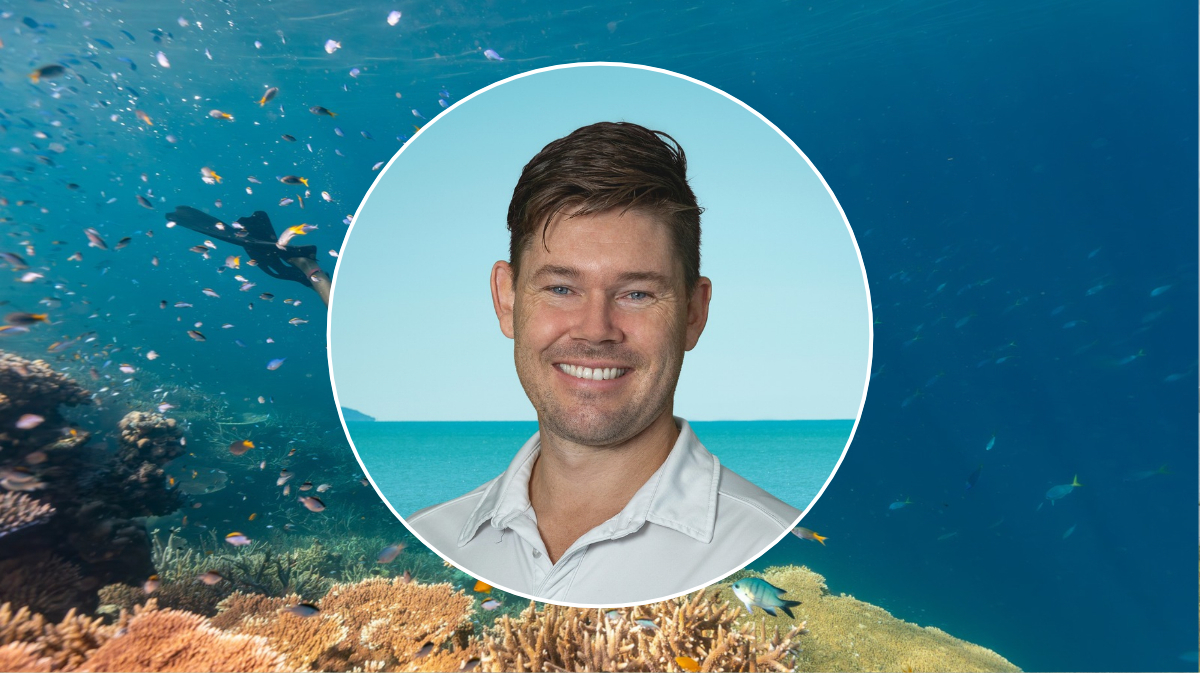
“I think I felt like it was a little bit broken. This can’t be everything that I’m trying to achieve with my career, just bringing in volumes of people and getting expenditure to occur. There’s got to be a little more to it.” – Tim Booth
What happens when a destination marketer reaches the top job and starts asking whether that’s all there is? Tim Booth, CEO of Tourism Whitsundays, spent nearly two decades in destination marketing organizations before that question caught up with him. The Whitsundays calls itself the heart of the Great Barrier Reef, one of the seven natural wonders of the world and a fragile one. If the reef is what draws travellers, Booth began to ask, shouldn’t the organization that promotes it also help protect it?
He found answers at Destination Think’s Forum 2025 in Queenstown, Aotearoa New Zealand, where voices such as Monique Kelly, co-founder of Wao, pushed him to rethink his organization’s role. He joined the Destination Think Collective as soon as he got home and has brought an infectious enthusiasm to it ever since.
Several changes have followed. The STARS program gathers operators’ sustainability stories and feeds them into the region’s tourism awards, with no written submission needed. A program with Reforest and Reef Catchments lets businesses and visitors fund restoration they can see in the region, a local alternative to carbon offsetting, and Booth plans to add seagrass and coral restoration in later stages. Industry networking nights dropped from six a year to four, and four 7 a.m. beach cleans were added.
Each change fits Tourism Whitsundays’ three-year plan to shift the organization’s role toward stewardship, starting with its natural icons, then the stories of local operators, then visitor behaviour change. The organization is now in the plan’s second year.
Booth takes inspiration from David Attenborough on why to become a steward rather than just a marketing organization: “No one will protect what they don’t care about, and no one will care about what they have never experienced.” And tourism is often the best way to deliver those experiences.
On this episode of the Travel Beyond podcast, you’ll learn:
- Why Tourism Whitsundays is moving from marketing the Great Barrier Reef to stewarding it, and what changed its CEO’s thinking.
- How a three-year plan in the Whitsundays moves from brand icons to operator stories to visitor behaviour change.
- How the STARS program helps Whitsundays businesses share their sustainability work without writing a single award submission.
- What the Whitsundays’ new regenerative program with Reforest and Reef Catchments offers local businesses and visiting travellers.
Subscribe to Travel Beyond through Apple Podcasts, Spotify, or your favourite podcast player.
Destination photo provided by Tourism Whitsundays.
Show notes
5 green themes from an energizing Forum 2025 in Queenstown, Aotearoa – Destination Think’s report from the five-day Collective gathering in Queenstown that sparked Booth’s rethink, including insights from Booth and from Wao co-founder Monique Kelly.
STARS program celebrates local stories – How Tourism Whitsundays’ STARS program invites businesses to share what’s new, their training, promotions, recognition and sustainability steps, so Tourism Whitsundays can celebrate them.
Tourism Whitsundays – The regional tourism organization for the Whitsundays in North Queensland, led by CEO Tim Booth, which markets the region as the heart of the Great Barrier Reef.
Tourism Whitsundays and Zhik partner to cement the Whitsundays as Australia’s home of sailing – The April 2026 corporate partnership with Sydney-founded sailing apparel brand Zhik, which also moves Tourism Whitsundays staff uniforms to Zhik’s sustainable apparel standards.
Tourism Whitsundays launches a program to help visitors and businesses give back – The April 2026 launch of the Reforest Regenerative Destination Program, delivered with Reforest and Reef Catchments, which lets businesses and visitors plant trees and restore local ecosystems.
Travel Beyond podcast: Everyone’s having a climate epiphany – The 2023 Travel Beyond episode with Monique Kelly, co-founder of Wao and Revology in Wānaka, on community organizing and the personal climate realizations that move people to act.
Episode transcript
Tim Booth: The David Attenborough quote is a good one on why to become a steward rather than just a marketing organization: “No one will protect what they don’t care about, and no one will care about what they have never experienced.” If we care about the place and care about the whole experience, and how we can make people connect to our place, wherever that is in the world, and if we can get more people to experience it, then they’ll think more broadly, maybe, about how they travel and what they think is important in their lives.
David Archer: Welcome to Travel Beyond. I’m David Archer from Destination Think, recording from Haida Gwaii, the territory of the Haida Nation off the north coast of British Columbia in Canada. On this show, we look at travel’s role in making a better world, and we highlight leading destinations and changemakers. Our guests are taking local action that the world can learn from.
They’re helping to regenerate ecosystems, communities and economies, and they’re often making positive change happen from the bottom up. Many of the voices we’ve highlighted are part of the Destination Think Collective, a peer group of dozens of ambitious, forward-thinking destinations working toward a better future for travel and the planet.
One of the main reasons the Collective exists is to help destinations accelerate good ideas and sustainability work by sharing back and forth with one another, and we absolutely love watching that happen. Today’s guest gives us a perfect example. Tim Booth is the CEO of Tourism Whitsundays, a destination considered to be a gateway to the Great Barrier Reef, and I would say that Tim brings an infectious enthusiasm to the Collective.
He says he’s been inspired by people we’ve met along the way as well, like Monique Kelly in Wānaka, over in Aotearoa New Zealand. We interviewed Monique on this podcast a few years ago, in an episode that’s definitely worth checking out called “Everyone’s having a climate epiphany,” where we talked about her work in community organizing and the realization so many of us have had at different times in our lives about the climate crisis and what our response needs to be.
In a way, Tim shares his own epiphanies in this episode as he reflects on what destination stewardship really means in such a sensitive and globally important ecosystem. How do you be a marketer and protect the environment? What happens after an epiphany? You have to do something about it. In this episode, Tim joins Brad Parsell from Kootenay Rockies Tourism to talk about how Tourism Whitsundays has been transforming to use tourism to protect and restore this amazing place.
Here are Brad and Tim.
Brad Parsell: I’m very excited about today’s guest, who is a part of the Collective. Super excited to have him here. First of all, welcome, Tim. Could you tell us your name, your role and where you work?
Tim Booth: Brad, thanks so much for having me. I’m Tim Booth, CEO of Tourism Whitsundays. The Whitsundays is located in North Queensland.
We are a world-class Great Barrier Reef destination. For listeners who haven’t ever looked at the size of the Great Barrier Reef on a map, if you were to flatten it out, it would be the size of Texas. When you say you’re a Great Barrier Reef destination, the Whitsundays makes up about 1% of the entirety of the Great Barrier Reef, as far as the size of the world’s largest living structure.
We’re a very small part of the world, but an absolutely beautiful part of the world, and I think that’s why we are world-famous.
Brad Parsell: Absolutely. I would assume that the Great Barrier Reef is one of your biggest motivators for travel to your part of the region. Would that be fair?
Tim Booth: Yes. When we look at all the research about why travellers want to come to the Whitsundays, the Great Barrier Reef is the number one calling card for Australia for international travellers. We have a world-famous icon in Heart Reef, so our tagline is “The Whitsundays is the heart of the Great Barrier Reef.”
One, we’re almost the midpoint, but two, we actually have a physical heart, and that becomes our logos and our calling cards as well. Depending on which listicle you follow, we have the number one beach in the world. This year we’re following Time Out, so thank you, Time Out. I appreciate the call-out.
Then there are 74 islands. We just got named as Expedia’s top island destination in Australia as well, looking at the top 10 island destinations around the world. That’s really exciting.
Brad Parsell: Well, that’s great context, and obviously protecting what all these people are coming to see is pretty important. We’re going to get back to that in a second here.
For a bit of context for our listeners, we’re on opposite sides of the world from each other, but we actually had the fortune of meeting almost a year ago now in Queenstown, New Zealand, at a Destination Think Collective event. Not long after that event, you got home and immediately joined the Destination Think Collective. Could you take a little bit of time to explain how that event in Queenstown and the Destination Think Collective have inspired or changed how you look at what you do at Tourism Whitsundays?
Tim Booth: Sure. I think this is my 18th or 19th year in a destination marketing organization, so this is how I’ve spent my entire working career in some way, shape or form. When I went to the Queenstown event, if I look back at it, I was thinking, “This can’t be it. This can’t be how you spend your entire career, getting to the stage where you’ve become a CEO,” which is, on a personal front, really pleasing, and there’s a good amount of growth that’s gone into being in that position.
Then you’re sitting at the table and you’re thinking, “What are we doing as far as looking after destinations?” There’s an element from a marketing perspective of that’s the role that I’m there to do, so I do that, or visitor servicing. But I felt like it was a little bit broken.
This can’t be everything that I’m trying to achieve with my career, just bringing in volumes of people and getting expenditure to occur. There’s got to be a little more to it. I was scratching my head and thinking, and had a lot of good conversations, particularly with Ben from Destination Think, in the lead-up to that Queenstown event.
I didn’t really know who I was walking into the room with, whether that was laziness on my part or I was just completely unsure. Then you sit down in the room, and it’s a really inspiring group, a collective.
Brad Parsell: Yes.
Tim Booth: The naming convention they’ve come up with is really cool.
Just that in and of itself is a way to get different opinions from all around the world and then be inspired. The community over in Queenstown is incredible as well. Having the opportunity to sit with world leaders and thinkers really blew my socks off. One, I can sit at this table and people are listening to what I’m saying, but two, there are a lot of lessons that you can pick up really quickly.
Sitting with the likes of Monique Kelly, I could listen to her all day. What an incredible individual. For me, it was the inspiration, or the kick in the pants, that I needed to recalibrate my own thinking. The reason to then immediately join is probably the biggest lesson: most of the problems that I’m facing, I’m just not doing anything about.
I’m just letting them be problems. You either do something about it, or it’s going to continue to be a problem in your life. You’ve got the choice. Again, fail fast and try to solve the problem. There are going to be 100 different ways to do it, and then you learn from others around you. What are the quick learnings you can do, the quick conversations you can have? Then just solve the problem and get on with it.
Brad Parsell: Coming back from that experience, you’ve done a lot since we met in Queenstown within the last year. What was the big takeaway? You’ve hit on it already: you’ve been historically very focused on marketing, and there was this pivot toward thinking about other things.
Tim Booth: Yes. It’s probably also a timing sequence. One, the world of marketing is changing so drastically in front of our eyes. Things that we were doing 12 months ago just don’t work anymore, or the tactics have to change or evolve based on AI and how the consumer is receiving information, particularly from a destination marketing perspective.
I think that’s been the piece for evolution. The way I’m reading it, and I don’t know if I’m right, but this is the path that I think is correct, so this is the path that I’m taking, is that you could fake it, if that’s the right word, with good marketing tactics, from an SEO perspective or ownership of a phrase. The consumer could only really find information in one generic way, through search, a lot of the time, and now we’re getting to the stage where you can no longer control the information that’s out there about the destination. If you’ve done really good marketing, maybe the destination didn’t actually live up to the standard the visitor or prospective visitor was looking for. To actually live up to that standard, you have to change what you’re trying to be, in my mind. As a destination, you start to become a steward, and you’re really trying to make sure that you set the standards of your destination, what you want to be known for, and then how you want your businesses to operate and act and perform in front of visitors from all around the world.
Brad Parsell: This move you’re talking about, and I’m pulling it back here to the Barrier Reef where we started, from just marketing the Great Barrier Reef to thinking about stewarding or protecting the Great Barrier Reef: what does that look like, and what have you been up to?
Tim Booth: I think it’s really important to understand that no matter what I do, probably from a destination stewardship or destination marketing perspective, if there are environmental impacts on the Great Barrier Reef, I will feel the repercussions, but I may not be able to change everything that is going to impact the Great Barrier Reef.
I have to make sure that I’m comfortable enough going to sleep at night and not feeling the stress of the entire world looking after one of the seven natural wonders of the world. I’ve got to make sure that I’m comfortable with that from the get-go. Then, if we’re now changing toward a stewardship function for our destination, we as a destination have to live the values that we’re trying to set for what we want visitors to be doing when they’re here in our region.
For that to occur, in my mind, we had to programmatically set up a three-year evolution of how we’re going to change how we do marketing and how we do relationship management for our destination. One, we needed to bunker down on what we want to be known for. We’ve got the 74 islands, we’ve got Whitehaven Beach, we’ve got Heart Reef, we’ve got the Great Barrier Reef, so we’ve got our icons in place.
That’s a brand platform of “naturally iconic.” Perfect. Now, in year two, we step into looking at the people. What makes our destination so unique is the incredible passion of all of our operators. We’re starting to bring those stories to light throughout this year, and then year three, which we’re yet to get to, is about behaviour change.
To get to behaviour change, we have to do the work in the background to make sure that, one, the operator is ready, and two, that we can start to talk to the visitor about behaviour change. We looked at CopenPay and those sorts of models, and the Love Queenstown model, and we couldn’t just turn that on overnight.
You can’t just say, “Okay, this is what we’re doing now.” We’ve got to get there a little bit at a time.
Brad Parsell: Totally.
Tim Booth: It’s one step forward, two steps back, and hopefully we’ll get to two steps forward, one step back. With that, we set out our agenda: what is it that we want?
What are the behaviours that we want visitors to be doing in three years’ time? Then we work our way back from there. What do we want our operators doing? We decided that we would invent a rewards program to incentivize our operators to celebrate the things that they’re inevitably doing all the time. We called that the Whitsundays STARS program, where we work through each of the letters meaning something, with sustainability being one of the key attributes.
Have you done something new at your business? What training have you put your staff through? What recommendations have you received? What awards have you received? And what’s something that you’re doing that’s sustainable? We then built that into our tourism awards, and you get 10 magical points.
The businesses are incentivized to actually start using the program, but then we can find out from businesses all around the Whitsundays really rapidly that they’re doing all of these incredible things. We’re celebrating all of the great things, and then it becomes a bit of keeping up with the Joneses for the businesses.
Brad Parsell: Yes.
Tim Booth: Totally. They’re thinking, “They get celebrated for doing A, B and C. Why don’t we tell them about what we do?” That’s the inevitable starting point for us: how do we incentivize businesses to be celebrated for doing the great things that they’re mostly already doing?
As I’m sure is the case in your part of the world, there are some incredible businesses that do all these great things but just do it because it’s the right thing to do. We just wanted the opportunity to celebrate that.
Brad Parsell: I think there are some really cool things in there, like the fact that you’re encouraging your operators to lead by example so that visitors see that.
You’ve also created criteria for your storytelling and marketing efforts, where people can just submit, “Hey, this is what I’m doing.” I think that’s really awesome.
Tim Booth: On top of that, every three months we can group together all those stories for our state tourism organization and national tourism organization: here’s everything that we’ve done sustainably in our region in the last three months. All of a sudden, that’s a heaps better storytelling piece than me reaching out because one business has done one thing. If I can show that 50 businesses have done these things, that’s just a really good story to be, one, told and, two, heard.
Brad Parsell: What else have you been up to in this transition over the last year?
You’ve mentioned the STARS stories and the tourism awards. Is there anything else that you’re looking at or thinking about in this space?
Tim Booth: We did have to do a realignment. Any time you’re going through change or transformation in how you’re going to be received and what you’re going to do, you still have to deliver the outcomes that you’ve got to deliver from a marketing set.
We’ve still got a contract, but we’ve got to take the staff on the journey a little bit. They need to start owning that as well. That’s a hard thing to record, what those success factors look like, but we’ve got to take the team on that journey and make sure that they want to own being a steward of a place.
That was certainly something in the background that we’ve worked pretty hard at, to make sure that the team really owns that space.
Brad Parsell: Do you feel the traction there? Do you feel your team and the operators, and even residents, getting behind this idea, or is it still early days?
Tim Booth: You would probably know as well as I do that you generally don’t get too many compliments when you’re sitting in the jobs that we’re doing. There’s an expectation that you deliver good stuff and you do your job. You get more direct feedback if there’s an operator or a citizen that’s unhappy with what you’re doing.
Through that process, particularly the awards and the STARS program, we’ve received a lot of feedback, particularly from smaller operators that just never felt like they could compete against the big guys, that they really like it, because now it gives them a level playing field. They just need to focus on good customer service, they need to focus on delivering an award-winning or world-recognizable product, and then they’re in a space where they can be competitive.
They don’t have to write an award submission anymore. We do it all based on this: you just run a really good business, and here are the 10 points that we’ll review it against. That gets a lot of positive feedback to us, which is great because, as I said, you don’t generally get too many people reaching out to say thank you, which is part of the gig. That’s been great.
Brad Parsell: That is cool. It seems like the program you’ve put together is a really low lift for the operators, which I think is important. I think that’s where we fall down sometimes with sustainability certifications. You have to pause your whole business for three months and fill out a lot of paperwork.
Tim Booth: Yes.
Brad Parsell: That can be challenging.
Tim Booth: We’ve also looked at a range of different ways for us to do this. At times, we forget the tourism industry’s pretty sexy. We’ve created a corporate relationship with a company called Zhik. They’re a sailing apparel company that sponsors a whole range of teams in the Olympics, and they sponsor teams as the apparel partner in SailGP.
We’ve chosen them because the countries they work with are our traditional Western markets: the UK, Germany, the USA. One, it’s a strategic choice, but two, we want to be known as the home of Australian sailing. We are likely to be the 2032 Olympic destination for sailing.
It’s a strategic, long-term choice. With that, we’ve then partnered with a state government entity called Reef Catchments to deliver a program called Reforest. Reforest is a regeneration program, so we’ll be doing a few announceables with industry. Next week, we’ve got our first roundtable with industry to talk about how the program will work throughout their businesses.
One, it gives businesses the opportunity to do regenerative practice in our region. Historically in the tourism space, we’ve had the ability to do carbon offsetting and all of those sorts of bits and pieces, and that seems to have been received with mixed feelings over the last decade.
We’re not necessarily trying to do just carbon removal. It’s allowing businesses locally to do regenerative practice. It’s very similar to the Love Queenstown model, where we’ll be able to have tree plantings, and you can buy square metres of how much space you want to regenerate.
It also gives the visitor the potential opportunity to either buy a tree or a square metre, or have their visit to the reef go into those things. There’s a carbon component to it, which is really cool, but there’s also the ability to capture runoff and remove sediment from waterways and all of those sorts of bits and pieces.
In stages two and three, we want to get to being able to do seagrass nurseries and coral restoration.
Brad Parsell: Awesome.
Tim Booth: The science that sits behind that is a little bit more complicated than planting a tree, but that’s okay. We want to look at being one of those world-class, world-leading regenerative spaces, with a lot of the education that needs to go alongside that, so visitors understand the impacts. If a seagrass nursery is disturbed, it can take years for it to be regenerated, so it’s not as easy as just planting a tree.
We want to take visitors through that space, and locals as well as businesses. That’s the ambition, and that’s going to be a really, really great piece that we’re going to roll out. There will be tree-planting days with the team and our members, as well as potentially having academies come up with their students and do tree plantings.
We’ve rolled that into another element as well. We were doing bimonthly industry networking nights. We’ve reduced the number that we’re doing, but now we’re doing breakfast beach cleans. We go and find a location with a local organization called Eco Barge Clean Seas
and get industry to come along at 7:00 in the morning, and we go and walk around for an hour. Did you ever call it the emu bob, where you walk around? I’m guessing that’s pretty much the same thing, actually, now that I think of it.
Brad Parsell: Yes. I went to school in Australia, for the listeners.
Tim Booth: Effectively, we wander around for an hour and pick up rubbish along beaches or waterways or wherever that may be, and then come back and buy everyone a coffee. It’s a great way to start a day, and it’s living those values that we want. As I said, by year three, what do we want visitors to be doing? If the industry’s doing it, then they’re going to proudly talk about it and own it as well. It’s a simple change. Instead of six networking nights, we go to four, and now we do four beach cleans a year. It’s just a slight little psychological change, but, gee, you feel really good after it. I know that sounds stupid, and we should probably all just do it all the time anyway, but it’s about having that moment where you’re doing it as a collective and as an industry, and just really caring for your place and the space that you live in.
Brad Parsell: When I was with Tourism Tofino, there was a beach clean program, and I can relate to what you’re saying.
For visitors, it was the highlight of their trip, which is funny, picking up trash, but it kind of was. It’s a really cool project. As it gets up on its feet and gets going, how do you specifically see the DMO’s role, or the tourism body’s role, in this? Is it purely promoting the program?
Tim Booth: I think it’s celebrating the businesses that are actively participating as well.
To your point, the visitor is changing what they see as a really rich experience when they travel. Potentially generationally, the younger generation wants to give back. All of the evidence is that they want to give back to the place where they’re going to stay. What does that look like?
I guess we’re just giving them a few opportunities. This might inspire industry to do something completely different that I haven’t even thought of. That’s probably, again, going back to that Queenstown piece: any good idea is a great idea. If it spits out something else, then let’s do it.
Let’s give it a go. From our side, as a marketing organization, it just allows us to celebrate what businesses in the Whitsundays are already doing 100 times over anyway. Instead of participating in a carbon offsetting program, they can now be rewarded and incentivized to celebrate and build something locally, which is great.
I’m guessing it’ll become its own product as far as where day-trippers go when they’re exploring the region. They’ll go past the forest that’s been planted, or the seagrass nursery that’s evolving and growing, because it brings in different wildlife. It brings in turtles and dugongs, and that will become a storytelling moment in and of itself.
Brad Parsell: 100%. Well, we’re looking to wrap up here. I can’t believe we’re almost out of time. That’s crazy. To wrap this up, do you have any advice for other destinations that are looking to start this journey you’ve started, in terms of pivoting from a complete marketing focus to more of a stewardship focus?
Tim Booth: I think the first thing would be to take the time to zoom out. Thinking back to that Queenstown week, I gave myself that entire week. I was still checking emails and doing those things, but every night I’d go back to the hotel room and really think on the day,
and then tie that to the problems that I was experiencing in my region. I guess that’s the bit. We’re all slightly different, but we’re all slightly the same. Just take the time to pause for a moment. What are your actual problems? You can get to the end of a week and feel exhausted, like the world’s…
“I’m never going to get through this. I’m not solving these problems.” But you can also zoom out, and there are some problems where you realize, actually, I’m creating this problem. Look at the thing: are you part of the problem, or are you actually helping solve that problem and move forward?
For me, it was really about this: what are those five or 10 things that cause daily grief, weekly grief? How can we solve this? How can we resolve this? Okay, then let’s take it on. If it’s something that we can do something about, then let’s go at it. But like I said, I can’t solve all of the world’s problems.
I can’t sit there in the role that I’m in and think, “I can solve global warming.” I can’t.
Brad Parsell: Totally.
Tim Booth: But what I can do is be a place in this world where people celebrate and love the natural environment that surrounds them, and we’re going to celebrate doing all the right things for it. That’s a contagious feeling.
That’s probably what I picked up when I was in Queenstown from all of the other people around the table: if you actually just love what you do and love where you are, you naturally want to care about it. That’s the other part. Don’t get bogged down in it. I guess the David Attenborough quote is maybe a good one to round out on why to become a steward rather than just a marketing organization: “No one will protect what they don’t care about, and no one will care about what they have never experienced.”
If we care about the place and care about the whole experience, and how we can make people connect to our place, wherever that is in the world… For us, it’s a really unique ecosystem, one of the seven wonders of the world. If we can get more people to experience it, then they’ll think more broadly, maybe, about how they travel and what they think is important in their lives.
I think they’ll do that every time they go on a trip, if every destination is really rapidly informing them. Then, to go to the Monique Kelly piece, the tourism industry needs to realize that it’s actually in the education industry. That was probably one of the most profound things that I remember from Queenstown, and I think about that almost daily. I think that’s part of the reason to become a steward: you’re no longer just marketing. You’re actually enabling people to connect with your place, wherever that is in the world, and then they become your ambassadors.
Brad Parsell: I think that’s a beautiful way to end it. Tim, thank you so much for your time today. I really appreciate it.
Tim Booth: Brad, always a pleasure. And well done on the mic for the first time. Congratulations. You nailed it.
Brad Parsell: Thanks, man. This has been Travel Beyond, presented by Destination Think. I’m Brad Parsell, CEO at Kootenay Rockies Tourism and a member of the Destination Think Collective.
Many thanks to Tim, CEO of Tourism Whitsundays, for joining me as today’s guest. For show notes and to learn more about the Collective, visit destinationthink.com. This episode was produced, with music composed, by David Archer. Amy Bjarnason and Katie Bauer also provided production support. If you like what you hear, please take a moment to give us a five-star rating on Apple Podcasts or Spotify.
It helps people find our show. We’ll be back next time.





0 Comments