

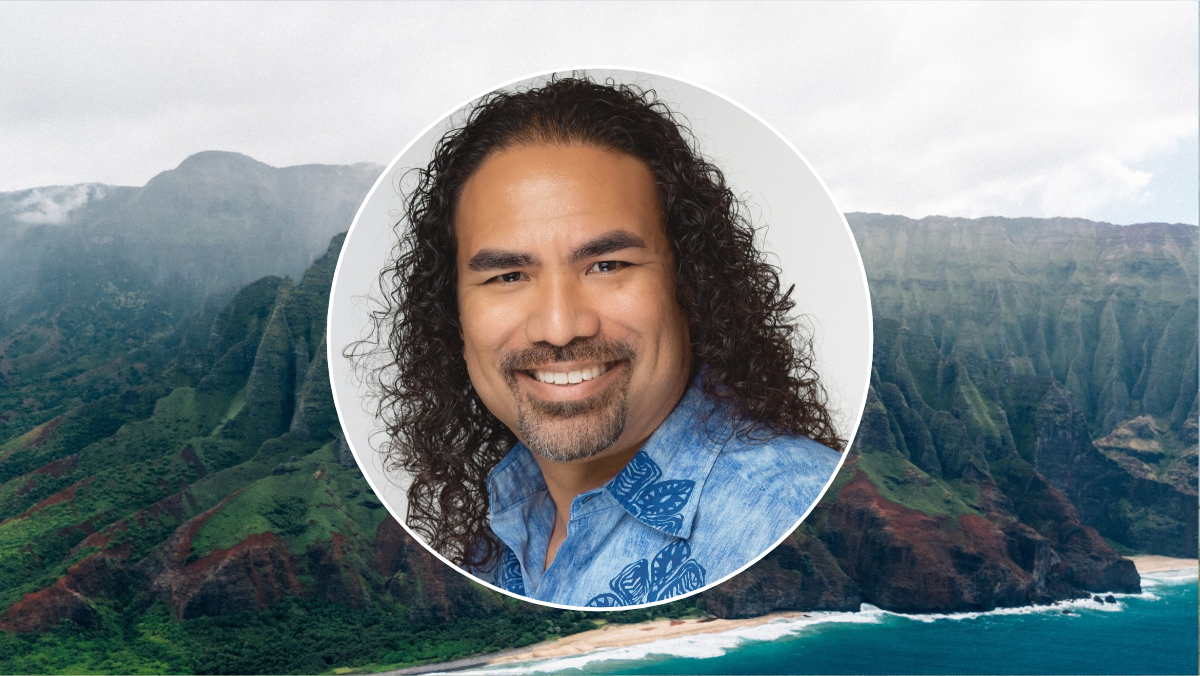
“Importing good people, exporting better humans.” – Dr. Aaron J. Salā, Hawaiʻi Visitors and Convention Bureau
What is tourism for? Dr. Aaron J. Salā, President and CEO of the Hawaiʻi Visitors and Convention Bureau (HVCB), answers with the philosophy that guides his organization’s regenerative tourism work: import good people, export better humans.
Tourism runs in his family: his father, a Polynesian dancer, co-founded South Pacific Island Airways, and his mother, a Polynesian entertainer, became a hotel executive.
Speaking with guest host Brad Parsell, CEO of Kootenay Rockies Tourism, Salā describes how HVCB is applying Act 128, the 2024 state law that mandated a regenerative tourism framework for Hawaiʻi. The bureau sets out to attract visitors who match its desired profile, then tries to send them home with a worldview drawn from life on islands with finite resources.
For residents, Salā says, regenerative tourism has to start and end with community. People who live in Hawaiʻi have to support the economic engine that brings visitors in, and then feel supported by it once the cycle is complete. He describes his role as being a bridge, working toward a day when residents no longer see themselves as separate from “what we currently call the industry.” That work includes the stories HVCB tells. He’s leading the organization to “really reconsider how it is that we put forth the kinds of stories that we tell about ourselves as representatives of our destination, of our home,” so that the Hawaiʻi visitors hear about is one that residents recognize as their own.
Salā is direct about the tensions. Native Hawaiians often carry more of tourism’s impacts than its benefits, and social media has sharpened those frictions. He points to aloha, which he defines as “I see myself in you,” and to Pacific welcome protocols in which a stranger becomes kin.
On this episode of Travel Beyond, you’ll learn:
- How the Hawaiʻi Visitors and Convention Bureau is turning Hawaiʻi’s 2024 regenerative tourism law into day-to-day practice.
- Why HVCB built a “Hawaiʻi target traveller” profile to decide which visitors it wants to attract.
- What the Hawaiian value of aloha, “I see myself in you,” means for how destinations welcome visitors.
- How Hawaiʻi’s history, from Martin Luther King Jr.’s Selma lei to Sun Yat-sen’s schooling in Honolulu, shaped its role in human diplomacy.
- Why the original meaning of the word tourism, “to turn,” still matters for destination leaders.
- What advice Salā offers leaders trying to bring more humanity into strategic plans and spreadsheets.
Catch the full episode on Travel Beyond through Apple Podcasts, Spotify, or your favourite player.
Destination photo provided by Hawaiʻi Visitors and Convention Bureau.
Show notes
Destination Think Collective – A peer group of dozens of tourism destinations, including HVCB, working toward a better future for travel and the planet.
Festival of Pacific Arts and Culture (FestPAC) – The June 2024 gathering of Pacific Island cultures in Honolulu, which Salā helped host.
Hawaiʻi Visitors and Convention Bureau – The private, nonprofit membership organization, led by Dr. Aaron J. Salā, that carries the story of Hawaiʻi to the world in partnership with the Hawaiʻi Tourism Authority.
Hawaiʻi’s regenerative tourism law (Act 128) – Signed June 28, 2024, the law built a regenerative tourism framework into the Hawaiʻi State Planning Act and the state’s Tourism Functional Plan.
Sun Yat-sen in Hawaiʻi – How the founding father of modern China studied at Honolulu’s Iolani School and founded the Revive China Society in Honolulu in 1894.
Why Martin Luther King Jr. wore a Hawaiian lei at Selma – The story behind the lei organized by Reverend Abraham Akaka of Kawaiaha’o Church and hand-delivered to marchers in Alabama in March 1965.
Episode transcript
Dr. Aaron Salā: The work of Hawaiʻi then is to impart a kind of worldview upon these visitors. The hopeful impact is that that experience then stays with you beyond your time here. And so from a visitor-focused angle, that’s the job of regenerative tourism: importing good people, exporting better humans.
David Archer: Welcome to Travel Beyond. I’m David Archer from Destination Think, recording from Haida Gwaii, the territory of the Haida Nation off the north coast of British Columbia in Canada. On this show, we look at travel’s role in making a better world, and we highlight leading destinations and change-makers. Our guests are taking local action that the world can learn from.
They’re helping to regenerate ecosystems, communities, and economies, and they’re often making positive change happen from the bottom up. Many of the voices we’ve highlighted are part of the Destination Think Collective, a peer group of dozens of ambitious, forward-thinking destinations working toward a better future for travel and the planet.
And today’s guest believes that Hawaiʻi can change the world, and he’s directing tourism towards what he sees as its ultimate purpose, to import good people and export better people. And we’ll unpack that in this episode. Dr. Aaron Salā leads the Hawaiʻi Visitors and Convention Bureau, and this episode is all about the big ideas.
What is tourism for? How can we evoke deeper meaning through the stories we tell about the places we live? And what are some Native Hawaiian ideas the world needs right now? Guest host Brad Parsell from Kootenay Rockies Tourism leads this conversation with Dr. Salā. And since this interview was recorded, Aaron also joined us to speak at our live World Tourism Day relay on September 24th, alongside five other members of the Collective around the world.
We heard from leaders in Copenhagen, Aruba, Queenstown, the Whitsundays, Banff and Lake Louise, and Hawaiʻi. It was quite a tour. And we talked about tourism’s potential for positive impacts and where we go from here. So if you enjoy this conversation, have a look at the Destination Think LinkedIn page, where you can sign up for access to the recording.
Now here are Brad and Aaron.
Brad Parsell: Okay, Aaron. So first of all, thank you so much for joining us today. Could you tell us your name, your role, and where you work?
Dr. Aaron Salā: Sure. I’m Aaron J. Salā. I’m president and CEO of the Hawaiʻi Visitors and Convention Bureau.
Brad Parsell: Awesome. Well, thank you so much for taking the time to be with us today, Aaron. I’ve been very, very excited about our conversation. To give folks some context, maybe I’ll ask you to introduce yourself a little bit: how long you’ve been in that role, your background, and then we can talk about the destination.
Dr. Aaron Salā: Sure thing. I’m just coming up on two years in the role.
Over the last 20 years, 25 years or so, I have served in a number of sectors, both public and private, working with government in the production of the IUCN World Conservation Congress, and hosting the 13th Festival of Pacific Arts and Culture here in 2024. I’ve done a lot of work. My training and trade, as it were, is in the creative industries. I have a PhD in ethnomusicology.
Brad Parsell: Oh, wow.
Dr. Aaron Salā: And so, degrees in music. I had planned to sing opera and conduct orchestras, by training, and really decided that I wanted to base my life here in Hawaiʻi. It’s a difficult thing to do, have a career in classical music living in Hawaiʻi.
And so I redirected and started to get into cultural and creative strategy, working with entities like Disney, Cirque du Soleil, and other organizations, really interested in connecting culture, cultural practice, and cultural story carrying and storytelling and story living into creative and production content.
This is a little bit of a tangent from that, but I think the work that we’re trying to do in tourism now through this organization is really to reconsider how it is that we put forth the kinds of stories that we tell about ourselves as representatives of our destination, of our home.
Brad Parsell: Amazing. Well, what an interesting background. And maybe for folks who aren’t familiar with the organization that you work for, is it connected to the Hawaiian state government? Is it independent? How is it structured?
Dr. Aaron Salā: We are an independent nonprofit membership trade organization. Hawaiʻi Visitors Bureau was incorporated in 1945 and changed our name in 1998 to the Hawaiʻi Visitors and Convention Bureau. But we have antecedents that run back to 1903, and so in totality, we are an organization about 123, 124 years old, responsible for the telling and carrying of the story of Hawaiʻi across the globe.
So again, we are a private nonprofit organization. Our biggest client, I should say, is the State of Hawaiʻi through the Hawaiʻi Tourism Authority, which is fiduciarily responsible for the tourism strategy on behalf of the State of Hawaiʻi.
Brad Parsell: Interesting. Has the organization historically had a lot of Indigenous or Native Hawaiian influence? I’m curious about that. I know we’re going to talk about culture a lot in this podcast.
Dr. Aaron Salā: Actually, I think that’s waxed and waned over time. Both of my parents were professionals in the industry, and so I sort of grew up in the industry-ness of Waikiki, et cetera, and the Pacific, ostensibly.
There was a time in my youth when the who’s who of Hawaiian culture and the who’s who of the tourism industry in Hawaiʻi wanted to work at the Hawaiʻi Visitors Bureau, because it was this platform for dynamic and diverse engagement as had to do with the role that culture played in the industry. And really, the role that the industry played in the perpetuation and celebration of culture. That has waned, in all honesty, over the last many years. But it is this sort of cycle.
Brad Parsell: Super interesting. How have you approached the last two years in your role? I know you said you’re coming up on your two-year anniversary here, but what are the things that, as you came into the CEO role, were really important to you and are driving you even today?
Dr. Aaron Salā: I think, apropos and akin to your immediately previous question, I grew up in the industry, but paying attention to the way that the industry provided a platform for the celebration of culture and, connected to that, this celebration of color consciousness.
My father was a Polynesian dancer turned airliner. He and a group of colleagues founded South Pacific Island Airways, which in the ’70s and ’80s was an airline before its time, hubbed in American Samoa. It served as an inter-island South Pacific airline, and they started to do long hauls all the way into Amsterdam. Interestingly enough, my mother likewise was a Polynesian entertainer turned mid-level hotel exec.
And so I grew up around this energy that brought to the fore a way of thinking that didn’t distinguish between who I am as a community member, who I am as a Native Hawaiian, and then the industry proper. There was this coalescence and cohesion, really this coherence, of how each of them informed the other.
And so when I came into this position, I came in really loving the opportunity that tourism provides for the engagement of people with story, and place with story, and place with culture, and people with other kinds of people. What I have endeavoured to do, on one hand, is to rehabilitate and maintain relationships with stakeholders up and down the industry and the community, and then also start to chart this course for how the industry will play a role in the convening of humanity in this next chapter of what the industry is becoming.
Brad Parsell: Totally. Certainly in my experience working in Tofino, and even coming from New Zealand myself, often, and I’m curious what this is like in Hawaiʻi, Indigenous folks disproportionately feel quite a lot of the impacts of tourism but aren’t necessarily feeling all of the benefits of tourism. I’m wondering what that feels like in the Hawaiʻi context.
Dr. Aaron Salā: Yeah, I mean, that’s 100% real here. Those tensions are palpable in many cases. And I think the role that social media has played in the proliferation and distribution of how those tensions, not just in Hawaiʻi but across the world, are felt and contended with, plays itself out in rather dynamic ways. In that way, Hawaiʻi is not unique.
Let me rewind a bit. You invoke your homeland in Aotearoa. If I come onto a marae in Aotearoa, there is a process by which I introduce myself and my intentions. And that introduction and that intention is received in a particular way and then responded to. And over the course of that engagement, where we are receiving each other, there is a moment of clarity that says, “Ah, you are no longer stranger, you are now kin.”
That is a gross oversimplification of the protocol of it. But I think there is this natural desire for humans to find ourselves in each other. And so in Hawaiʻi, that is called aloha. That I see myself in you.
And there is this process, and the process through the industry and over time is so much less formal than a traditional Hawaiian society would’ve expected it to be. But there is this desire to understand the role that I play in the life of a friend, in the life of a brother, and in the life of a stranger.
And so what has become really interesting to me in the doing of this work is refinding our way back to how tourism plays out as a platform for human engagement. And as a platform for human engagement, more than an economic driver of sorts, what we are doing is effecting humanity rather than affecting the potential of humanity.
And so, for all the highfalutin philosophy of it, for me it’s a really tactical effort to assure that what we’re trying to do is provide a platform for the celebration of color consciousness, so that humans can find ourselves in each other again.
Brad Parsell: How important do you think that is? We’re in this age where there are lots of forces out there trying to divide us. There’s AI running rampant through our industry and others. Do you think that’s going to place a premium on this human connection, like what you’re talking about? Or do you think we’re going to have to fight for that human connection?
Dr. Aaron Salā: It’s one of those things where, if you can stand back at a macro enough level and follow the evolution of industries and the evolution of humanity and the evolution of technology, et cetera, over time, there was a moment when I was being reared whereby, if you really wanted to do well, you had to go into engineering, you had to go into computer science, and you had to be technologically driven. And now we’re in this place where that generation is exactly that.
And now, in this world of AI and technology that moves so much faster than really the speed of light, where we find ourselves now is that the next generation has to be creative, has to be humanistic, has to find the core value of life again, and then connect that into, on one hand, continuing to check AI, but also leveraging the power of AI with an infused humanity, to decide what the next evolution of this all becomes.
And so if you stand back far enough, there are these cycles of thought and cycles of processes over time that help us to understand how we got to this point, first of all, and then how we embark on whatever the next chapter for us is meant to be.
Brad Parsell: Yeah, absolutely. To your point, that human connection, I mean, that’s why we travel, right? We travel to see new things and meet new people and experience new places, and I think that’s always going to be hugely important. And Hawaiʻi is an iconic, globally recognized destination, right? Lots of visitation, I’m sure, and lots of money flowing through the islands. How do you take that cultural approach to what is ostensibly really big business? How are you trying to fuse those two worlds together? Are you trying to centre residents and Native Hawaiians, while also being conscious of the fact that this is a huge economic machine for the State of Hawaiʻi?
Dr. Aaron Salā: I think my direct response to your question is: that’s the work. That’s the everyday coming to work and trying to figure it through, right? And so from a tactical, legislative perspective, the state enacted Act 128, I think in the legislative session of 2024, and that act established for us and mandated a regenerative tourism framework.
The Hawaiʻi Tourism Authority then took that regenerative tourism framework and the pillars of it and further defined what it is. And so our job as the bureau, whose client is the Hawaiʻi Tourism Authority, is to take that and tactify it on the ground. The way that we look at regenerative tourism as an organizational philosophy is to import good people and export better humans.
From a visitor’s perspective, we have what we call a Hawaiʻi target traveller, and that Hawaiʻi target traveller is a series of psychographics and levels of expectation for our target audience for Hawaiʻi. And so if those are good people, we bring those, quote-unquote, “good people” into Hawaiʻi.
And over the course of their experience here, in product, in participating in cultural and other activities, et cetera, the work of Hawaiʻi then is to impart a kind of worldview upon these visitors. And as a result of that worldview, where we are cognizant of our role in a destination like ours, a finite geography with finite resources, and we’ve found a way to live together, to breathe together, to share those finite resources, the hopeful impact is that that experience then stays with you beyond your time here. From a visitor-focused angle, that’s the job of regenerative tourism: importing good people, exporting better humans.
Regenerative tourism from a local construct, however, is a mechanism whereby the regenerativity of it starts with community and ends with community. Because the community has to support the mechanism that brings this economic engine in, and then has to feel supported at the end as a result of that cycle of economics. And so, as you can imagine, that’s no small feat, especially given where you’re pointing to in terms of the tensions of community and the big business of it.
And I just come back constantly to the opportunity, in this case, for Hawaiʻi to play a global role in the evolution of the industry. I don’t want to overspeak here and dominate for a little bit, but if we go back to the etymology of the word tourism, we come back to this idea of turning off the normal path. If I’m walking home from school, that’s the normal path. But if I decide to check out what’s happening down this street, which will loop around, that’s really the origin of the idea to tour, which means to turn.
And so in the beginning of it, as a kind of rite of passage, it was really about men of noble families exploring, going on the grand tour to explore what’s happening in the world.
Well, I think we continue to know that it is a human condition to travel. We’ve been travelling since the beginning of humans, across ice, across the ocean, across mountains. And so it is a human condition to travel. How tourism plays into that human condition, I think, is on the precipice of its next chapter, and we want to be an effective leader in that evolution.
Brad Parsell: That’s so fascinating. So what do you think are the things that Hawaiʻi can teach the world in this kind of space?
Dr. Aaron Salā: So, if I continue to acknowledge consistently the tensions between who we are as a community and how the industry plays out, what I see my role as is continually working to build and/or be a bridge, so that at some point we don’t see ourselves as distinct, as a community, from what we currently call the industry. And that may be a pie-in-the-sky kind of dream for someone like Aaron.
When I think about the role that Hawaiʻi has played: in 1960, JFK had endeavoured to announce his campaign for President of the United States in Hawaiʻi, because he saw Hawaiʻi as this necessary hub, really more than a gateway, between the West and the East. He didn’t make it. He ended up, I think, announcing it in Alaska, if I’m not mistaken. But he had endeavoured to make that announcement here, because he saw the role that Hawaiʻi would play in the geopolitics of the United States of the time.
Martin Luther King wore lei, the Hawaiian flower garland, in his march on Selma. And what prompted that was that Martin Luther King Jr. had come here to work with Reverend Akaka at Kawaiahaʻo Church, one of our oldest churches in Hawaiʻi.
Brad Parsell: Wow.
Dr. Aaron Salā: And that, for him, reified this aspiration that was guided by peaceful resistance. And so when he went back to Selma, Kawaiahaʻo Church had sent a delegation to march with him on Selma, and there’s this very iconic photo of Martin Luther King in that front line, all wearing lei, as provided to him by Hawaiʻi.
And so there are these lists of Sun Yat-sen and the work that Sun Yat-sen did in Hawaiʻi, and that was informative for him and the work that he was doing in the East.
So all that to say that Hawaiʻi really does play this very impactful role in the diplomatic humanity of humans, or the human diplomacy of diplomacy. And I completely buy into and truly believe in the power that Hawaiʻi has indicated and has sort of proof-of-concepted, as exemplified by these few examples: the power of Hawaiʻi to play this international, global role in how we view difference and how we engage with the tensions, the dynamic tensions, of that difference.
And so for me, tourism then is so much more than an economic driver. Tourism is this platform for human engagement. And if we can continue to build into the platform the processes, again, back to your acknowledgement of Aotearoa and the processes, a very Pacific worldview, that provides a mechanism for us to see ourselves in each other, as different as we may initially consider that to be.
Brad Parsell: I think that’s such a beautiful sentiment, and it’s why I’m still involved with tourism, frankly: clinging onto that idea that there’s so much value in this human connection. I’ve been fortunate to travel to many places around the world, and it’s certainly made me a richer person. It opened my heart, and I think that’s travel at its best, right?
Dr. Aaron Salā: Absolutely.
Brad Parsell: As we look to wrap up here, Aaron, thank you again so much for your time. Is there any advice you’d give to other CEOs or destination leaders who are trying to infuse this humanity into what can be, let’s face it, a lot of spreadsheets and strategic plans? Any advice on humanizing tourism for folks?
Dr. Aaron Salā: Yeah, you know, in all honesty, far be it from me to offer advice. I feel like I’m just a kid in the room trying to learn about what’s happening in the world from the masters of the world. And I think, if there were any advice, it would be that in many, many ways, on many layers, in this multivalent world in which we live, in this multivalent industry in which we work, the opportunity to continually learn from each other about the work that we’re all trying to do, in terms of finding who we are and the role that we play in the world, is so key.
And I think there’s the opportunity for us to really think through that. At the end of the day, we are story carriers and storytellers, because we all live story. And so the power of that, I don’t think, should ever be diminished. I mean, what is the story that we’re trying to tell, and who are the people that need to hear it, and who are the people that need to engage within it?
I think that is the bedrock and cornerstone of how we continue along the lines of becoming, ever becoming, in the world. And I appreciate this time with you, Brad. Thank you so, so much, and this opportunity to engage with our team at Destination Think. We’re learning so, so much. Thank you. Mahalo nui.
Brad Parsell: Yeah, me too. Well, a massive thank you to you, Aaron. I feel like you and I could talk for another two hours.
Dr. Aaron Salā: Yes, for sure. Absolutely.
Brad Parsell: We have to cut it off. But really, really appreciate you. Thanks so much.
Dr. Aaron Salā: Aloha. Kia ora.
Brad Parsell: Kia ora. So this has been Travel Beyond, presented by Destination Think. I’m Brad Parsell, the CEO at Kootenay Rockies Tourism and a member of the Destination Think Collective. Many, many thanks again to Aaron, the CEO at the Hawaiʻi Visitors and Convention Bureau, for your time and your insights.
For show notes and to learn more about the Destination Think Collective, please visit destinationthink.com. This episode was produced and has music composed by David Archer. Amy Bjarnason and Katie Bauer also provided some production support. If you like what you hear, please take a moment to give us a rating on Apple Podcasts or Spotify. It helps more people find us. We’ll be back next time, so until then, take care.




0 Comments